

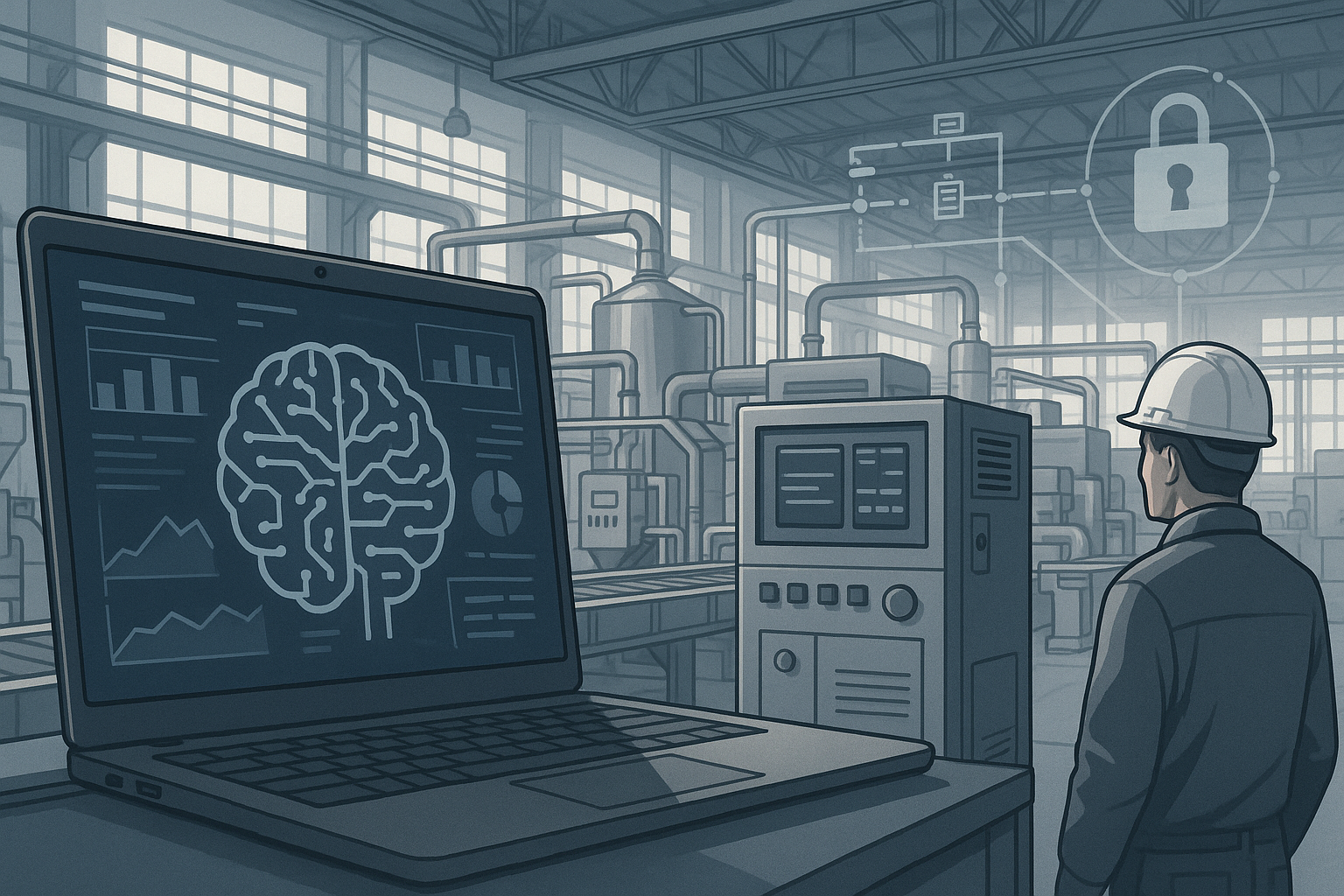
Industrial AI reaches production when it changes a real operating decision inside a workflow the plant already trusts. That usually means one KPI-tied use case, live access to the right plant systems, a clear owner, defined limits on what the AI may recommend or do, and OT security controls that fit the site’s normal standards. Pilots often stall before that point. They show that a model can detect an anomaly, classify an image, or answer a question, but they stop short of defining how the output will affect maintenance, quality, or production day after day.
In a plant, production does not automatically mean closed-loop autonomous control. It often starts lower on the risk ladder: a troubleshooting assistant that retrieves alarm history and prior fixes, a vision model that routes questionable parts to QA review, or a maintenance model that creates a recommended work order. Automatic setpoint or recipe changes come later because they cross into deterministic control and need tighter validation, simulation, and fallback plans (IndustryWeek, Mar. 27, 2026; Control Global, June 12, 2026).
Where Pilots Usually Fail
Common failure points tend to show up in the same places: - the model sees signals but not operating context - the use case is not tied to a plant KPI - getting data in or actions out still depends on brittle custom work - no one has defined approval limits, failover behavior, or change control - OT and cybersecurity teams are not comfortable with the connectivity model
A pilot can survive on exported CSVs, one internal champion, and manual interpretation. A live deployment cannot. Smart Industry argued in May 2026 that industrial AI needs a data ops foundation to grow beyond isolated use cases. Automation World made a parallel point in February 2026 when it framed the next step in manufacturing as moving from chatbots to action (Smart Industry, May 27, 2026; Automation World, Feb. 25, 2026).
- Start With One KPI-Tied Decision
The first deployment is far easier when the use case is narrow enough to score and important enough that operations will care. Good starting points include earlier detection of asset problems on one line, lower false rejects in one inspection cell, or faster troubleshooting for one recurring downtime mode. The label is less important than the decision path: who receives the output, what system records it, what action follows, and which metric should move if the output is right.
A common maintenance pilot on a packaging line shows the difference. A model flags rising bearing risk on one conveyor motor. That alert is still only a pilot output if it lands in an email. It becomes a production tool when it confirms the asset ID, checks whether the motor is already scheduled for work, creates a reviewed CMMS task, and records the result so the team can see whether the recommendation prevented downtime. If the same plant later wants the system to influence speed or sequencing, that is a separate stage with deeper control validation.
- Add Operational Context Before Adding More Data
Sensor data alone rarely explains enough. For most industrial use cases, the model needs more than tags and timestamps. It needs asset identity, recipe or batch state, alarm history, maintenance records, quality results, production orders, and operator events from systems such as SCADA, historians, MES, ERP, and CMMS. Smart Industry’s May 2026 article stated the point directly: industrial AI needs a data ops foundation, not just a larger pool of raw data. Automation.com’s June 2026 coverage likewise tied AI value to real-time operational insight and automation (Smart Industry, May 27, 2026; Automation.com, June 1, 2026).
Without that operating detail, an anomaly model may flag a normal changeover as failure risk. A quality model may detect drift but miss that it started after a recipe change or upstream tooling adjustment. A knowledge assistant may retrieve the right manual yet still miss the last three maintenance notes that explain why the same fault keeps returning. More data volume does not solve that problem. Better data relationships do.
- Fix the Integration Layer That Blocks Routine Use
This is where the control and software stack starts to matter, but not every use case touches it in the same way. Knowledge retrieval tools mostly need clean read access, identity control, and reliable links to source systems. Vision and anomaly applications usually need dependable event handling at the edge and a handoff into QA, MES, or CMMS. Closed-loop optimization is the category most likely to require deeper integration with SCADA, DCS, or PLC environments.
Automation World reported in April 2026 on tighter IT and SCADA development models, while Control Engineering highlighted software-defined control as a way to make applications more portable and change management faster (Automation World, Apr. 27, 2026; Control Engineering, Jan. 30, 2026). The practical value for AI is straightforward: cleaner interfaces and more flexible software layers reduce the engineering effort required to deploy, update, and reuse applications.
The takeaway is narrower than “modernize everything.” Find the layer that is stopping routine use. On one site, that may be inconsistent tag models or poor historian access. On another, it may be the lack of a reliable handoff from SCADA to MES or from an edge application into a maintenance system. Fix that bottleneck first. If every new AI use case requires custom integration, separate deployment tooling, and manual data cleanup, the program becomes hard to repeat even when the model itself works.
- Set Operating Limits and Own the Lifecycle
Many teams can describe what the model predicts, but not what authority it has once the prediction arrives. That is a governance gap, not a data-science gap. A maintenance assistant that drafts a work order, a scheduler that reprioritizes jobs for review, and a system that changes a process parameter all sit at different risk levels.
For most plants, the first live deployment should stay on the advisory or supervisory side of that line. PLCs, DCSs, interlocks, and safety systems remain the deterministic backbone. AI can improve decisions above those layers long before it is trusted to move parameters on its own. Control Global’s June 2026 article framed the industry’s shift in terms of “reasoning,” a useful reminder that better reasoning is not the same as granting new control authority (Control Global, June 12, 2026).
Staying deployed matters just as much as getting deployed. NIST’s AI Risk Management Framework treats AI as an ongoing governance, measurement, and management problem, not a one-time installation (NIST AI RMF, accessed June 23, 2026). In plant terms, that means naming an owner for model performance, defining what drift looks like, deciding who can approve a new version or retraining cycle, and establishing rollback or failover behavior if the model, data feed, or connection fails. A pilot can ignore those questions for a month. A production system cannot.
- Build OT Security Into the Deployment Path
Once an AI application connects historians, edge nodes, remote support tools, cloud services, MES, or CMMS, it becomes part of the OT operating environment, not a detached analytics sandbox. ISA says the ISA/IEC 62443 family spans policies and procedures, system requirements, and component requirements for industrial automation and control system security (ISA/IEC 62443, accessed June 23, 2026). NIST SP 800-82 Rev. 3 likewise emphasizes core OT practices such as segmentation, access control, remote access management, and monitoring for industrial control systems (NIST SP 800-82 Rev. 3, accessed June 23, 2026).
Security questions should be answered before expansion, not after. Which systems can the application read? Can it write anywhere, or only create recommendations? How is remote support approved? How are credentials managed and logs retained? What is the safe state if the model becomes unavailable or returns an implausible result?
A plant does not need a separate AI-only security program before it can start. It does need to apply its existing OT disciplines to the new data paths and decision paths AI introduces. That is often what turns a promising pilot into a deployment operations will accept.
The Practical Test Before Go-Live
Before a team calls any AI project a production deployment, it should be able to answer five questions: what operating decision changes, which KPI proves value, what plant and business context the model needs, who owns monitoring and rollback, and what OT security rules govern access and outputs. If those answers are clear, moving from one line to several becomes a manageable engineering program. If they are not, the site may have a useful demo, but it does not yet have a repeatable plant system.
Sources consulted
- Automation World, “Moving AI From Chatbots to Action in Manufacturing,” Feb. 25, 2026 — https://www.automationworld.com/analytics/article/55358665/mesa-international-moving-ai-from-chatbots-to-action-in-manufacturing
- Automation World, “The Convergence of IT and SCADA: A New Model for Industrial Automation Development,” Apr. 27, 2026 — https://www.automationworld.com/control/article/55373301/control-system-integrators-association-csia-the-convergence-of-it-and-scada-a-new-model-for-industrial-automation-development
- Control Engineering, “Use software-defined control to get smarter, faster, more agile manufacturing,” Jan. 30, 2026 — https://www.controleng.com/use-software-defined-control-to-get-smarter-faster-more-agile-manufacturing/
- Automation.com, “Manufacturing Drives AI with Real-Time Insights and Automation,” June 1, 2026 — https://www.automation.com/article/manufacturing-drives-ai-real-time-insights-automation
- Smart Industry, “Why industrial AI requires a data ops foundation to scale,” May 27, 2026 — https://www.smartindustry.com/artificial-intelligence/article/55379550/why-industrial-ai-requires-a-data-ops-foundation-to-scale
- IndustryWeek, “4 Fundamentals on the Path to Autonomous Manufacturing,” Mar. 27, 2026 — https://www.industryweek.com/technology-and-iiot/automation/article/55366866/4-fundamentals-on-the-path-to-autonomous-manufacturing
- Control Global, “Industry shifts from automation to reasoning,” June 12, 2026 — https://www.controlglobal.com/network/industrial-networks/article/55383796/controls-industries-shift-from-automation-to-reasoning
- ISA, “ISA/IEC 62443 Series of Standards,” accessed June 23, 2026 — https://www.isa.org/standards-and-publications/isa-standards/isa-iec-62443-series-of-standards
- NIST, “Artificial Intelligence Risk Management Framework,” accessed June 23, 2026 — https://www.nist.gov/itl/ai-risk-management-framework
- NIST, “Guide to Operational Technology (OT) Security,” accessed June 23, 2026 — https://csrc.nist.gov/pubs/sp/800/82/r3/final