

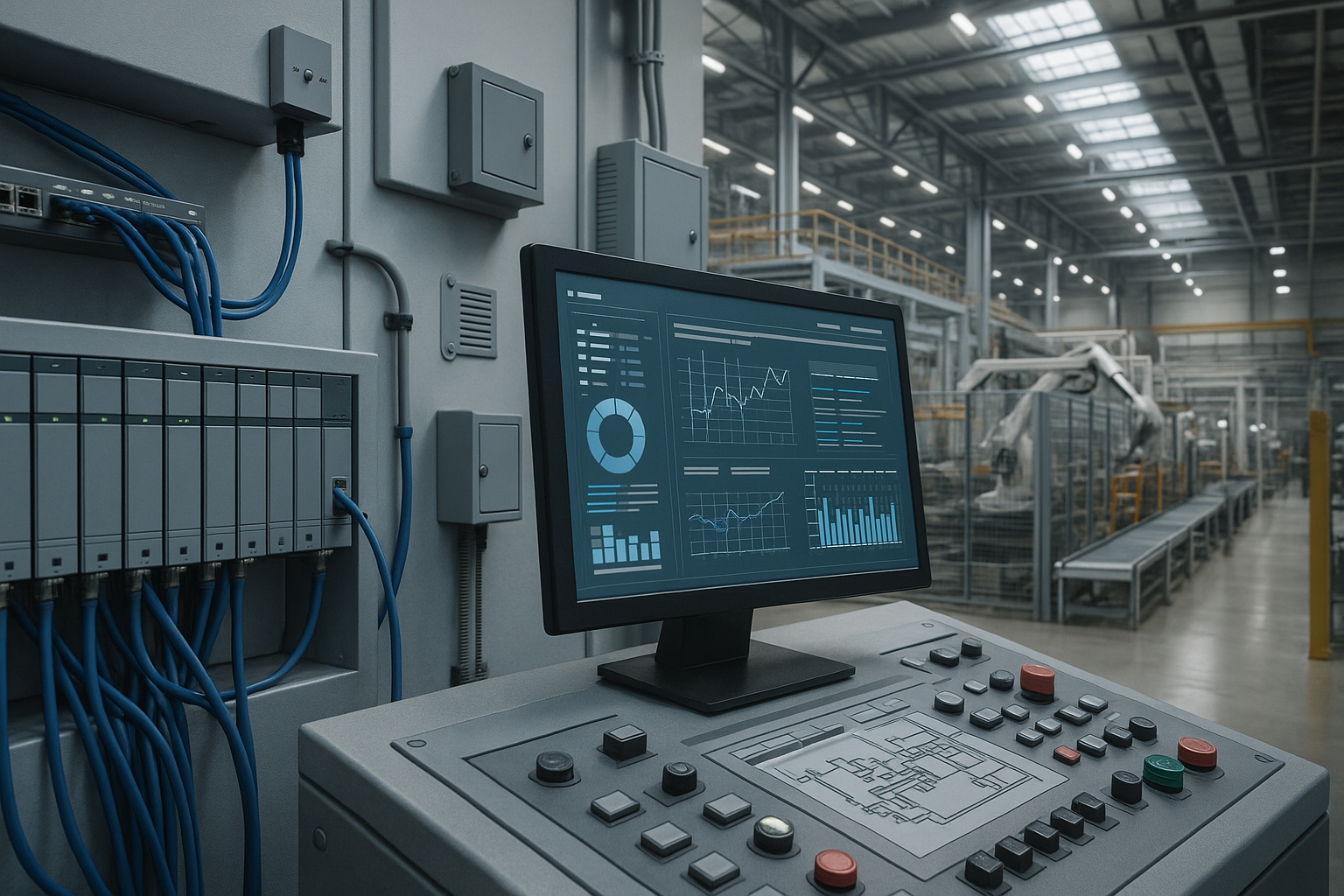
Manufacturers do not need to tear out every older PLC, DCS, or HMI to get useful industrial AI into production. In most existing plants, the least disruptive path is more disciplined than dramatic: leave deterministic control in place, collect data in read-only fashion first, improve the supervisory tools operators already trust, keep early AI use cases in advisory mode, and prove backup and rollback procedures before expanding (Automation World, accessed May 12, 2026; IndustryWeek, accessed May 12, 2026).
The urgency is real, but so is the execution gap. Smart Industry, summarizing Cisco research, reported that many manufacturers see AI opportunity while their infrastructure is already under strain (Smart Industry, accessed May 12, 2026). In a live plant, that gap appears quickly. The model may look promising in a pilot, yet the rollout stalls when tags are inconsistent, historian events do not match HMI states, or no one has defined how the plant falls back if the new software stack fails.
First decide what stays and what must change
Not every legacy asset should be protected, and not every older asset is a problem. As a rule of thumb, equipment can usually stay in the first phase if it is stable, still supported, understood by maintenance, and able to expose the needed data without unsafe workarounds. Replacement or isolation moves up the priority list when lifecycle support has ended, spare parts or engineering access are disappearing, safety or capacity are constrained, or networking and access control cannot be cleaned up without unacceptable risk.
That keep-or-replace screen is more useful than age alone. A 15-year-old controller that still runs reliably, has supportable spares, and is not the bottleneck may deserve to stay in service. A newer asset that cannot be backed up, segmented, or integrated cleanly may be the bigger modernization problem.
A low-disruption sequence
Before getting into the five areas, it helps to make the rollout sequence explicit:
- Choose one production problem tied to uptime, quality, energy, or changeover loss.
- Capture the required data without altering live control.
- Standardize names, states, and operator views before model rollout.
- Validate AI output in shadow or advisory mode.
- Expand only after rollback and restore have been tested.
That sequence works in both discrete and process environments because it keeps the first learning cycle away from time-critical control.
Consider a common retrofit scenario. A packaging line runs reliably, but downtime by machine, quality by SKU, and maintenance actions all live in separate systems. Or a batch unit has dependable DCS logic, but historian tags, phase data, and operator notes are inconsistent. In either case, the least disruptive move is not to rewrite control logic. It is to mirror the right data into an edge or historian tier, tie events to product or batch context, update the operator-facing view so everyone sees the same states, and let AI surface likely causes or maintenance priorities while supervisors compare the output with real events.
Layer 1: Give raw signals operating context
AI does not need the most data; it needs data that means something operationally. A temperature, current draw, or fault bit becomes useful when it is tied to the asset, machine state, recipe or SKU, shift, quality result, maintenance history, and time. ISA’s industrial AI material and Control Engineering’s AI integration coverage both reinforce that context is what turns signals into decision support (ISA, accessed May 12, 2026; Control Engineering, accessed May 12, 2026).
For discrete operations, that may mean linking stop codes to changeover stage, line speed, and reject rate. For process operations, it may mean tying loop behavior to batch phase, feedstock, or operator intervention. Without that context, AI can still find patterns, but the plant will struggle to decide whether those patterns are useful, explainable, or actionable.
The lowest-risk tactic is to add context above the control system first, through historians, event models, or data mapping, before touching working logic. Start with one use case and one area. If the plant cannot define the tags, events, units, and source of truth for a single loss problem, a larger AI program will only scale the confusion.
Layer 2: Create a safe, reliable path from control to applications
Once the data has meaning, it has to move reliably. This area is about transport, buffering, protocol translation, and identity management, not model selection. The architectural rule is straightforward: keep time-sensitive control local, and place data collection, normalization, and analytics one tier above it. That separation shows up repeatedly in SCADA modernization and autonomous-manufacturing discussions because it reduces the chance that an analytics experiment becomes a control upset (Automation World, accessed May 12, 2026; IndustryWeek, accessed May 12, 2026).
For low-disruption rollouts, start read-only. Mirror tags rather than rewriting logic. Buffer data at the edge so a network interruption does not break the application. Decide early which calculations must remain local for latency or availability reasons. If remote access is required for support, define who can connect, how credentials are governed, and how the plant keeps running if the new service disappears.
The goal is not architectural elegance. It is to create a dependable path from machine or process data to supervisory and analytic systems without introducing a new single point of failure.
Layer 3: Clean up the supervisory layer people already use
Connectivity gets data out. The supervisory layer turns it into action. In a process plant, that means SCADA, DCS graphics, alarms, historian views, and batch records. In a discrete plant, it may include HMI standards, line dashboards, downtime workflows, and MES handoffs. If those systems disagree on names, states, or timestamps, the plant will struggle to trust any AI output.
That is why supervision deserves its own modernization step. Control Engineering’s SCADA roundtable and Automation World’s IT/SCADA convergence reporting both point to the growing role of supervisory software as the handoff point between OT and wider business systems (Control Engineering, accessed May 12, 2026; Automation World, accessed May 12, 2026). The practical question is not whether the platform is old or new. It is whether operators, maintenance, engineering, and production leaders can see consistent plant states and follow the same workflow.
To avoid unnecessary downtime, run new screens, dashboards, or historian mappings in parallel before cutover. Validate alarm behavior with the people who use it. Schedule workflow changes during planned windows, train by shift, and keep a documented rollback path to the prior view. Plants lose time on supervisory changes less because the software is new than because the workflow changed without enough validation.
Layer 4: Put AI under change control before it is allowed to influence production
Once data and supervisory workflows are in order, the next question is procedural: what is the AI allowed to do? Observe, recommend, or act? In retrofit programs, advisory mode is usually the lowest-risk starting point because it lets the plant validate usefulness, timing, and operator acceptance before automation authority changes hands. ISA’s industrial AI guidance supports that emphasis on human roles and disciplined deployment, while Automation.com’s recent discussion of AI in industrial software development points to the same need for version control, review, and traceability as AI enters engineering workflows (ISA, accessed May 12, 2026; Automation.com, accessed May 12, 2026).
This is where management of change becomes central to the “without disrupting production” promise. Any change that affects recommendations, screens, operator steps, setpoint suggestions, or remote access should have an owner, an approval path, a validation period, and a defined fallback state. Run the model in shadow mode if necessary. Compare its recommendations with operator decisions. Record which model version was active and when it changed.
Training also belongs here, not at the end. The operators, supervisors, and technicians who will see the new output need to know what it means, when to trust it, and how to override it. If the answer to “What happens when this is wrong at 2 a.m.?” is unclear, the use case is not ready for wider rollout.
Layer 5: Build recovery and access discipline into the design
Every AI project adds software, connections, identities, and support paths. That makes recoverability part of the architecture, not a separate cybersecurity task to revisit later. Industrial Cyber has recently highlighted recovery readiness, resilience, and production continuity as defining concerns for manufacturing security, and that framing fits AI modernization work well (Industrial Cyber, accessed May 12, 2026).
Minimum discipline here is practical. Maintain an up-to-date inventory of the assets and services the new use case depends on. Document data flows and remote-access paths. Back up configurations for gateways, historians, SCADA applications, and user roles. Test how the plant restores those systems and in what order. Just as important, verify that local control can continue safely when the new analytics or AI service is unavailable.
That final test says a lot about whether the architecture is ready. If an edge server fails, a model update is rolled back, or a remote connection is severed, production should degrade gracefully rather than stop abruptly. The same design choice that limits downtime also limits cyber exposure: the plant remains able to run its core process while the added digital tier is repaired.
Practical takeaway
For most manufacturers, making legacy automation AI-ready is not a story about replacing everything old. It is a story about deciding what still earns its place, then strengthening five areas around it: context, connectivity, supervision, governance, and recovery. If a controller is stable, supportable, and not the bottleneck, leave it alone for now. Spend the first modernization dollars where they reduce risk and make data and decisions more usable.
That is how AI gets from pilot to production without unnecessary disruption. Read data before you rewrite logic. Run new tools in parallel before cutover. Put recommendations under change control before they influence the process. Prove that the plant can fall back cleanly before you scale. Those steps may be less dramatic than a rip-and-replace program, but they are far more likely to protect uptime while delivering usable results.
Sources consulted
- Note: All links below were accessed May 12, 2026. Where the research brief did not preserve a publication date, inline citations use access dates rather than guessed publication dates.
- Automation World — “Augment, Don’t Replace: The New Playbook for AI in Industrial Automation”
- https://www.automationworld.com/factory/digital-transformation/article/55372960/augment-dont-replace-the-new-playbook-for-ai-in-industrial-automation
- Automation World — “The Convergence of IT and SCADA: A New Model for Industrial Automation Development”
- https://www.automationworld.com/control/article/55373301/control-system-integrators-association-csia-the-convergence-of-it-and-scada-a-new-model-for-industrial-automation-development
- Control Engineering — “AI expert explains trends in AI automation integration”
- https://www.controleng.com/ai-expert-explains-trends-in-ai-automation-integration/
- Control Engineering — “Roundtable: SCADA’s role in industrial control”
- https://www.controleng.com/roundtable-scadas-role-in-industrial-control/
- Automation.com — “How AI Is Transforming Industrial Automation Software Development”
- https://www.automation.com/article/how-ai-transforming-industrial-automation-software-development
- Smart Industry — “Crystal Ball 2026: The Year AI Moves From Promise to Production”
- https://www.smartindustry.com/special-reports/article/55337079/crystal-ball-2026-the-year-ai-moves-from-promise-to-production
- Smart Industry — “New Cisco AI study sees widening execution gap, strain on manufacturing infrastructure”
- https://www.smartindustry.com/industry-news/news/55361036/new-cisco-ai-study-sees-widening-execution-gap-strain-on-manufacturing-infrastructure
- ISA — “ISA Explores Industrial AI’s Impact on Automation in a New Position Paper”
- https://www.isa.org/news-press-releases/2025/november/isa-explores-industrial-ai-s-impact-on-automation
- IndustryWeek — “4 Fundamentals on the Path to Autonomous Manufacturing”
- https://www.industryweek.com/technology-and-iiot/automation/article/55366866/4-fundamentals-on-the-path-to-autonomous-manufacturing
- Industrial Cyber — “Manufacturing cybersecurity entering operational era defined by recovery readiness, resilience and production continuity”
- https://industrialcyber.co/icevents/manufacturing-cybersecurity-entering-operational-era-defined-by-recovery-readiness-resilience-and-production-continuity/