

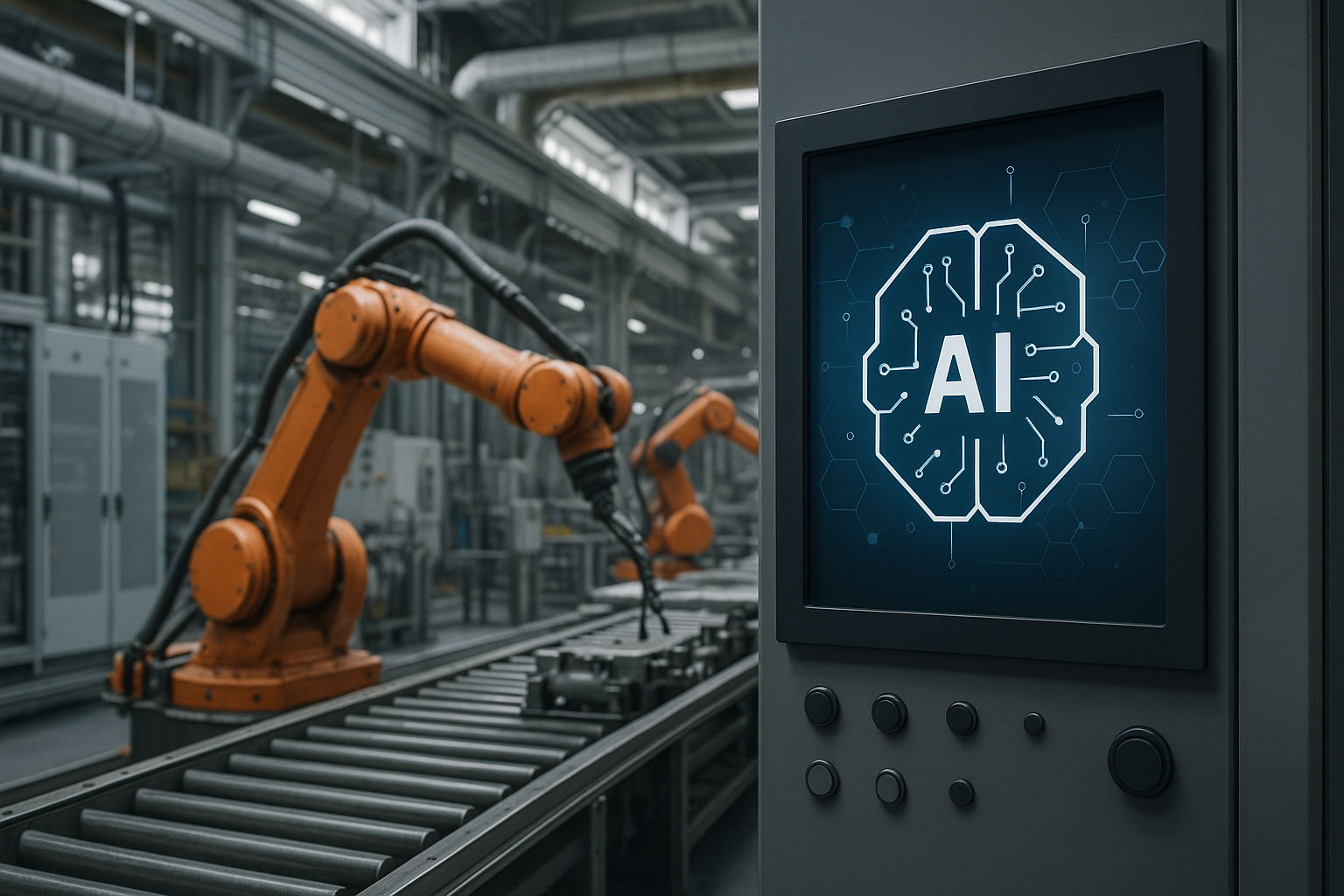
For many manufacturers, the quickest path to AI value now appears to be adding intelligence around existing operations, not replacing PLCs or DCSs outright (Automation World, April 28, 2026; Control Engineering, February 19, 2026). In existing plants, the better first move is usually to apply AI in inspection, maintenance, engineering support, scheduling, or robot cells while the control system continues doing deterministic control—the predictable, time-critical execution that keeps equipment and processes stable.
That distinction reduces risk and makes the business case easier to test. If AI starts as decision support instead of direct control, a plant can tie the pilot to one KPI—scrap rate, first-pass yield, mean time to repair, schedule adherence, or energy per unit—and prove value without disturbing the control backbone. Recent reporting across industrial trade outlets is increasingly pointing toward that staged approach: improve established workflows first, then expand only when the data, ownership, and cybersecurity foundations are ready (Smart Industry, May 20, 2026; Automation.com, May 1, 2026).
Start with workflows, not controllers
In this context, “above the control layer” does not mean AI is removed from production. It means the software sits in applications that inform work—vision systems, engineering search tools, maintenance applications, manufacturing execution systems, schedulers, or operator advisories—rather than writing directly into controller logic or setpoints. The control platform still owns the real-time task; AI improves how people prepare, prioritize, and respond around it.
The first question, then, is operational rather than architectural: which workflow is costing the plant the most in scrap, downtime, engineering hours, energy, or changeover losses? Recent reporting across automation and manufacturing outlets is converging on a measured answer—prove AI on a defined workflow first, rather than treating it as the front end of a wholesale automation reset (Automation World, April 28, 2026; Smart Industry, May 20, 2026). Controller modernization may still be necessary for lifecycle, supportability, or flexibility reasons, but it does not need to be a prerequisite for an AI project.
Where the first returns tend to show up
As a working rule, the strongest early use cases have clear owners, rely on data plants already collect, and can start without direct write access to controllers. That is why trade coverage keeps circling back to a familiar set of applications rather than promising fully autonomous factories (Automation World, April 28, 2026; Control Engineering, February 19, 2026).
Engineering support and troubleshooting
Engineering support is attractive because the information problem is already obvious. Drawings, change logs, alarm histories, manuals, work instructions, and technician notes often exist, but they are hard to search across systems. Recent industrial AI coverage increasingly highlights engineering and knowledge-work assistance as a low-risk way to cut search and troubleshooting time (Automation World, April 28, 2026; Control Engineering, February 19, 2026). On an existing line, this kind of tool sits in documentation and workflow systems, not in the control program, so it can be piloted with relatively little production risk. Practical KPIs include engineering hours recovered, faster fault isolation, and shorter mean time to repair.
Quality and inspection
Inspection is often a good next step because cameras, edge compute, and review workflows can usually be upgraded without replacing machine control. The most useful first move is rarely fully autonomous inspection. It is better triage: flagging likely defects, classifying exceptions, and sending questionable parts or images to a human reviewer. That keeps the quality engineer or inspector in the loop while improving scrap detection, first-pass yield, false-reject rates, and response time to process drift.
Maintenance prioritization
Maintenance teams already live inside a rich mix of signals: historian trends, alarm sequences, vibration data, computerized maintenance management system (CMMS) records, work orders, and technician notes. Used well, AI can rank likely causes, surface repeating failure patterns, and help the team decide which asset deserves attention first. That fits the lifecycle-oriented AI approach described in current process-manufacturing coverage, where value starts with better diagnosis and prioritization long before anyone considers direct automated intervention (Control Engineering, February 19, 2026). Measure it against unplanned downtime, repeat failures, mean time to repair, or technician productivity.
Scheduling and energy coordination
Some of the best opportunities sit a step farther from the machine. Scheduling, dispatch, labor allocation, and energy use already depend on information spread across MES, ERP, historian, and utility data. AI can help planners compare scenarios—throughput versus changeovers, labor availability versus due dates, energy cost versus output—without changing the controller strategy on the floor. This is where an orchestration layer becomes important. In plain terms, it is the software and data-management layer that moves context and tasks across systems so production decisions reflect both plant conditions and business constraints, not just isolated tags (Automation.com, May 1, 2026). Good KPIs here include schedule adherence, changeover losses, overtime, and energy consumed per unit.
Flexible robotics on mixed-product lines
Robotics belongs in the same conversation, but the brownfield path needs to be spelled out. In many existing plants, the conveyor logic, safety system, and machine controls stay in place; the AI value appears around the robot cell through better vision, part-variation handling, easier program changes, or simpler operator interaction. A3 reported in May that Q1 2026 robot demand broadened across non-automotive industries, and its February coverage linked AI-enabled low-code and no-code tools to reduced deployment friction (Automate.org, May 13, 2026; Automate.org, February 10, 2026). For higher-mix operations, the useful KPIs are usually changeover time, successful picks or placements, cell uptime, and the labor required to reconfigure the application.
What must be in place first
Contextualized data
Raw tags are rarely enough. AI becomes more useful when equipment signals are tied to asset identity, batches, recipes, maintenance history, quality results, and work processes. Without that context, a pilot may produce interesting output that nobody can act on. Recent coverage on orchestration, hybrid operations, and digital twins is reinforcing the same point: context is what turns industrial data into something operations can use (Automation.com, May 1, 2026; Machine Design, June 2, 2026).
Clear IT/OT ownership
Plants also need defined ownership before a pilot scales. Data quality, access rights, workflow integration, model monitoring, and user support do not manage themselves. That responsibility rarely sits in one department alone, which is why IT/OT alignment keeps showing up as a practical success factor in current coverage (Smart Industry, May 20, 2026). If operations, engineering, and IT are not aligned on who owns the data path and who responds when output starts affecting production decisions, the pilot will struggle to move beyond the demo stage.
Secure access and network boundaries
AI projects often expand connectivity between plant systems, edge devices, enterprise applications, and, in some cases, outside support teams. That makes remote access, identities, network segmentation, vendor access rules, and patching discipline part of the project scope early, not late. A 2026 Control Engineering report noted that industrial organizations often overestimate the strength of their remote-access security, which is a useful warning for plants planning to scale access beyond a single pilot (Control Engineering, 2026). Supplier roadmaps are also linking AI and OT security more closely; Industrial Cyber’s April coverage of Siemens’ Industrial Edge expansion is one example of that convergence (Industrial Cyber, April 27, 2026).
Guardrails between decision support and automated action
A prudent starting point is read-only insight or decision support. If a plant wants to move beyond that, the application should meet a higher bar: stable operating conditions, defined limits, validated data quality, visible confidence thresholds, human override, and an easy rollback path. The point is not open-ended autonomy. It is a bounded application where the team can say exactly what the model may influence, under which conditions, and how performance will be checked over time. That staged logic aligns with recent reporting on industrial AI adoption, orchestration, and lifecycle use (Automation World, April 28, 2026; Control Engineering, February 19, 2026; Automation.com, May 1, 2026).
How to scale without raising the risk too early
A sensible rollout has three steps. First, use AI to summarize, classify, or flag issues in read-only mode. Next, let it support a person’s decision inside an existing workflow—for example, recommending a maintenance priority, suggesting a schedule option, or routing an inspection result for review. Only after that should the plant consider bounded automated action, and only in low-consequence use cases with fixed rules and strong fallbacks. Examples might include routing a suspect part to manual inspection or calling a preapproved robot recipe after part classification; it is not the same thing as letting a general-purpose model run a unit operation.
Many plants will get enough value from the first two stages and may never need anything more ambitious. That is not a failure. The goal is better plant performance, not autonomy for its own sake.
Practical takeaway
For many manufacturers, the immediate AI opportunity is not controller replacement. It is a workflow bottleneck with a measurable KPI: scrap, uptime, labor, schedule performance, or energy intensity. That direction runs consistently through 2026 coverage on industrial AI, orchestration, and IT/OT integration (Automation World, April 28, 2026; Automation.com, May 1, 2026; Smart Industry, May 20, 2026).
If a pilot cannot show value while the system is still advisory, it does not belong any closer to control. Prove it as decision support first. Then decide whether anything more is actually warranted.
Sources consulted
- Automation World. “Augment, Don’t Replace: The New Playbook for AI in Industrial Automation.” April 28, 2026. https://www.automationworld.com/factory/digital-transformation/article/55372960/augment-dont-replace-the-new-playbook-for-ai-in-industrial-automation
- Automation.com. “The Industrial Orchestration Layer: Empowering Shop Floor Intelligence.” May 1, 2026. https://www.automation.com/article/industrial-orchestration-layer-shop-floor-intelligence
- Automate.org / A3. “How AI is Shaping the Future of Robotics with Low-Code and No-Code Solutions.” February 10, 2026. https://www.automate.org/ai/industry-insights/ai-low-code-and-no-code-solutions-in-robotics
- Automate.org / A3. “Robot Orders Hold Steady in Q1 2026 as Demand Broadens Across Non-Automotive Industries.” May 13, 2026. https://www.automate.org/robotics/industry-statistics/robot-orders-hold-steady-in-q1-2026-as-demand-broadens-across-non-automotive-industries
- Control Engineering. “Lifecycle-ready AI: Unlocking Value at Every Stage of Process Manufacturing.” February 19, 2026. https://www.controleng.com/lifecycle-ready-ai-unlocking-value-at-every-stage-of-process-manufacturing/
- Control Engineering. “Industrial Organizations Overestimate Remote Access Security, New Global Report Finds.” 2026. https://www.controleng.com/industrial-organizations-overestimate-remote-access-security-new-global-report-finds/
- Industrial Cyber. “Siemens Expands Industrial Edge to Accelerate AI Integration and Strengthen OT Cybersecurity.” April 27, 2026. https://industrialcyber.co/news/siemens-expands-industrial-edge-to-accelerate-ai-integration-and-strengthen-ot-cybersecurity/
- Machine Design. “AVEVA World 2026: Kim Custeau on AI, Hybrid Operations and Industrial Digital Twins.” June 2, 2026. https://www.machinedesign.com/automation-iiot/video/55381544/aveva-aveva-world-2026-kim-custeau-on-ai-hybrid-operations-and-industrial-digital-twins
- Smart Industry. “Integrating IT, OT, and AI for Real-World Competitiveness.” May 20, 2026. https://www.smartindustry.com/artificial-intelligence/article/55378460/integrating-it-ot-and-ai-for-real-world-competitiveness