

Industrial AI is not short on attention. In many plants, it is short on the operating conditions that let a promising pilot hold up under production conditions. In industrial terms, “scale” does not mean proving a model on one line or one asset. It means repeated use across shifts, products, lines, or sites without constant engineering intervention. Automation World’s “Augment, Don’t Replace: The New Playbook for AI in Industrial Automation,” its companion piece “Why Industry 4.0 Still Hasn’t Scaled...and What Must Change,” and Control Global’s “Reality check: is your plant ready for AI?” all frame that gap as a readiness problem, not a model-selection problem (all accessed July 17, 2026).
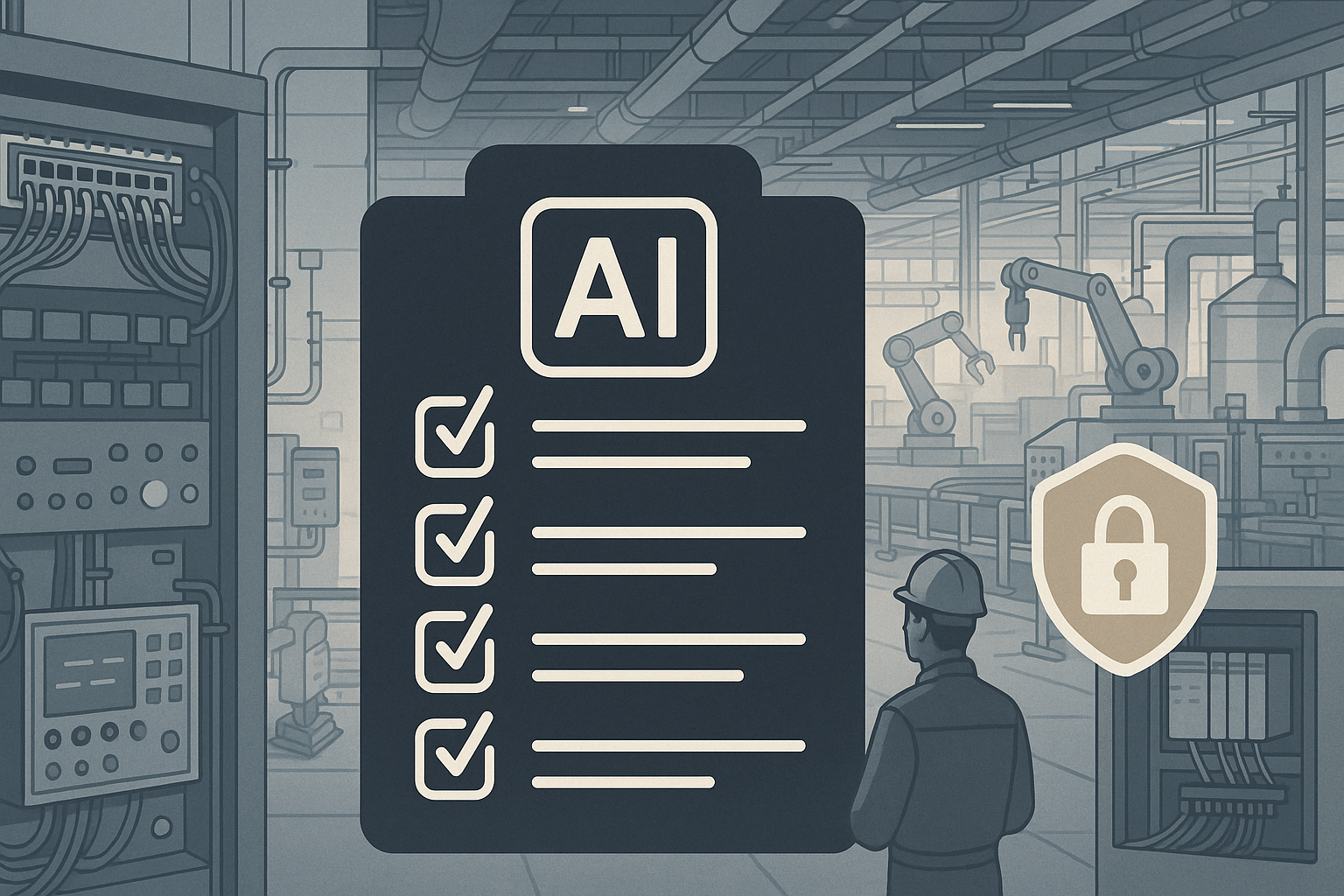
Before approving another pilot, ask six questions:
- Is there one repeatable decision with one owner and one KPI?
- Are the required data clean and tied to operating context?
- Can the OT/IT architecture deliver the data where it needs to go, reliably and with the right latency?
- Does the application fit the plant’s existing control and work systems?
- Are cybersecurity, change control, and fallback behavior defined?
- Do operators, maintenance, and engineering know when to accept, override, or escalate the result?
If several of those answers are no, the next project is not AI scale. It is plant preparation.
A representative stalled pilot makes the point. Imagine a packaging line using AI vision to detect seal defects. Offline, the model looks strong. On the floor, false rejects jump after changeovers because the image stream is not linked to SKU, line speed, seal-jaw temperature, or lighting state. Maintenance events are also missing, so a dirty lens and a real defect can look similar. Once the team adds that context, standardizes camera setup, and gives quality ownership of the accept/reject rules, the application becomes useful. The bottleneck was not the model. It was the plant.
- Is there one decision and one owner?
Plants get further when they start with a repeatable operational decision, not a broad “AI program.” Automation.com’s “From the Editor: Eight AI Trends Reshaping Industrial Operations in 2026” points toward phased adoption, while Control Global’s readiness piece emphasizes plant preparedness over broad ambition (both accessed July 17, 2026).
The test is simple: when the system produces a recommendation or classification, who acts on it, in what system, and against what KPI? Good starting points are narrow and frequent: defect classification at a vision station, maintenance prioritization for a class of rotating assets, exception handling in a robot cell, or operator guidance around a recurring process upset.
Weak starting points are easy to recognize. “Use AI for optimization” is not a use case. Neither is “put a copilot on top of the plant.” If no one owns the decision, the workflow is undefined, or the benefit cannot be measured, the pilot may be technically interesting but operationally fragile.
- Are the data trustworthy and placed in context?
The next gate is not more data. It is better data with enough process or production context to support action. Automation World’s “Augment, Don’t Replace” and Smart Industry’s “Integrating IT, OT, and AI for real-world competitiveness” both emphasize that industrial AI depends on trustworthy operational data and disciplined context-building, not just access to large volumes of tags or files (both accessed July 17, 2026).
In a process plant, an anomaly score is weak if it is separated from instrument health, operating mode, batch or recipe state, lab results, and maintenance history. In a discrete plant, a vision result is less useful if it is not tied to part genealogy, station state, tooling condition, and shift or changeover information.
This is where many pilots slow down. Historians may have the tags, but not the event markers. Maintenance systems may have the work history, but not the timestamps in a form the model can use. Images may exist, but not the labels that distinguish a cosmetic issue from a true defect. Until that context is built, the plant is asking the model to answer a question the data does not actually contain.
- Can the architecture survive after the pilot?
Data quality answers whether the information is credible. Architecture answers whether the application can run reliably after the demo phase. Smart Industry’s OT/IT integration article and Automation.com’s “Industrial AI Moves: Physical Operations Readiness Gaps Determine Scale” make the same point: industrial AI scales when the data path, compute location, and system ownership are designed for operations, not just for experimentation (both accessed July 17, 2026).
That means deciding early where the model will run and why. Will it run at the edge near the machine for speed and resilience, in a central environment for easier management, or in a hybrid arrangement? What happens if the WAN link drops? Which system is the source of truth when the historian, MES, and maintenance system disagree? How will time alignment be handled across tags, events, and images? Network performance matters here; bandwidth, latency, and segmentation determine whether image streams, historian data, and work-order context arrive where they are needed.
Those questions are less glamorous than model selection, but they are what separate a pilot from a durable application. If the data path depends on manual exports, one-off scripts, or a single engineer who understands the workaround, the plant does not yet have a production architecture.
- Does the application fit brownfield operations?
Architecture is about plumbing. Brownfield fit is about workflow. Most plants are not starting from a blank page; they are adding new capabilities to existing PLCs, DCSs, SCADA systems, historians, MES platforms, and robot cells. Automation World’s “Augment, Don’t Replace” argues directly for that approach, and Control Global’s “Honeywell, Nvidia chart new path for industrial autonomy” also treats autonomy as a layered progression built on industrial context rather than a leap over it (both accessed July 17, 2026).
That is also the right way to read the surge of interest in physical AI after Automate 2026. In that coverage, physical AI generally means AI coupled to physical systems—robots, vision, motion, and cell-level orchestration—so equipment can adapt to variation instead of following only rigid sequences. Automate.org’s “How Physical AI Could Make Industrial Robots Easier to Deploy,” Smart Industry’s Automate 2026 roundup, and Machine Design’s interview with A3’s Jeff Burnstein all described the idea in practical deployment terms, not as frictionless autonomy (all accessed July 17, 2026).
For most brownfield operations, the sensible path is still staged. First comes detection, classification, or advisory guidance. Next comes supervised optimization. Only after the data, architecture, and exception handling are proven should a plant consider tighter automation around the result.
In process environments, that may mean adding AI guidance beside the DCS and advanced process control (APC) layer rather than letting it write directly to control strategies. In discrete environments, it may mean using AI to help with vision inspection, robot teaching, or material-flow decisions while keeping supervisory rules intact. If an application only works after a major controls rewrite or a full software-stack replacement, it is probably not the right first-scale candidate.
- Are cybersecurity and governance defined?
Every AI deployment adds something to manage: new connections, new identities, new software updates, new data flows, or new human-machine interfaces. Industrial Cyber’s feature on aligning OT cybersecurity with uptime, safety, and throughput is useful here because it frames cyber risk the way plants already understand it—as a production and resilience issue, not just an IT issue (accessed July 17, 2026).
The practical governance questions are straightforward. Who approves model updates? What happens if the service is unavailable on a night shift? What logs are kept when a recommendation is accepted or overridden? How are remote access, credentials, and segmentation handled? If the application feeds an operational decision, what is the fallback mode when confidence is low or communication is lost?
Plants do not need a separate cyber philosophy for AI. They need to place AI inside the same OT security, change-control, backup, and recovery discipline expected of other production systems. If that governance model is vague, the application is not ready to move closer to automatic execution.
- Do people know how to use it?
The human question is not a soft add-on at the end of the project. It is part of deployment. Automation World’s “Augment, Don’t Replace” makes that case directly, and IndustryWeek’s “Now Interacting: Robotics and AI in Manufacturing” reflects the same theme on the factory side: AI is changing how people interact with automation, not removing the need for supervision and judgment (both accessed July 17, 2026).
That trust depends on three things. First, the recommendation must be understandable enough for an operator, technician, or engineer to judge whether it fits the current state of the plant. Second, the limits of the system’s authority must be explicit. Third, exception handling must be written into the workflow, not left to improvisation.
A useful rule is this: keep an application in advisory mode until the plant can prove four things at once—stable data, repeatable results, defined exceptions, and a clean fallback path. When those conditions are in place, moving to tighter automation becomes a business and risk decision. Until then, human review is part of the control strategy.
What to assess first on Monday morning
The fastest next step is not another vendor demo. It is a one-hour readiness review with operations, controls, maintenance, IT, and cybersecurity in the same room. Score the six gates red, yellow, or green. If the first two gates—use case and data context—are red, spend the next quarter on sensor health, historian cleanup, timestamps, event markers, labeling, and workflow ownership. If all six are at least yellow, and one use case has a named owner and KPI, then one advisory AI application may be ready to move into limited production use on a line, cell, or asset class.
That is the real dividing line in industrial AI today. Plants do not scale because they bought the newest model. They scale because they prepared the environment around it.
Sources consulted
- All links below were accessed July 17, 2026.
- Automation World. “Augment, Don’t Replace: The New Playbook for AI in Industrial Automation.”
- https://www.automationworld.com/factory/digital-transformation/article/55372960/augment-dont-replace-the-new-playbook-for-ai-in-industrial-automation
- Automation World. “Why Industry 4.0 Still Hasn’t Scaled...and What Must Change.”
- https://www.automationworld.com/factory/digital-transformation/article/55390548/how-to-properly-scale-industry-40
- Automation.com. “From the Editor: Eight AI Trends Reshaping Industrial Operations in 2026.”
- https://www.automation.com/article/eight-ai-trends-reshaping-industrial-operations-2026
- Automation.com. “Industrial AI Moves: Physical Operations Readiness Gaps Determine Scale.”
- https://www.automation.com/article/industrial-ai-moves-physical-operations-readiness-gaps-determine-scale
- Smart Industry. “Integrating IT, OT, and AI for real-world competitiveness.”
- https://www.smartindustry.com/artificial-intelligence/article/55378460/integrating-it-ot-and-ai-for-real-world-competitiveness
- Smart Industry. “Blog: Manufacturing tech companies showcase big themes, trends at Automate 2026.”
- https://www.smartindustry.com/industry-news/blog/55387518/blog-manufacturing-tech-companies-showcase-big-themes-trends-at-automate-2026
- IndustryWeek. “Now Interacting: Robotics and AI in Manufacturing.”
- https://www.industryweek.com/technology-and-iiot/robotics/article/55378176/now-interacting-robotics-and-ai-in-manufacturing
- Machine Design. “Automation as Strategy: A3’s Jeff Burnstein on the State of Robotics Adoption, AI and Scaling.”
- https://www.machinedesign.com/show-coverage/automate/video/55383391/automation-as-strategy-a3s-jeff-burnstein-on-the-state-of-robotics-adoption-ai-and-scaling
- Automate.org. “How Physical AI Could Make Industrial Robots Easier to Deploy.”
- https://www.automate.org/robotics/industry-insights/how-physical-ai-could-make-industrial-robots-easier-to-deploy
- Control Global. “Reality check: is your plant ready for AI?”
- https://www.controlglobal.com/control/ai-ml/article/55389223/how-to-ensure-your-plant-is-ready-for-artificial-intelligence-adoption
- Control Global. “Honeywell, Nvidia chart new path for industrial autonomy.”
- https://www.controlglobal.com/show-coverage/honeywell-users-group/article/55383664/honeywell-nvidia-chart-new-path-for-industrial-autonomy
- Industrial Cyber. “Aligning OT cybersecurity with uptime, safety, and throughput as digital transformation reshapes industrial risk.”
- https://industrialcyber.co/features/aligning-ot-cybersecurity-with-uptime-safety-and-throughput-as-digital-transformation-reshapes-industrial-risk/