

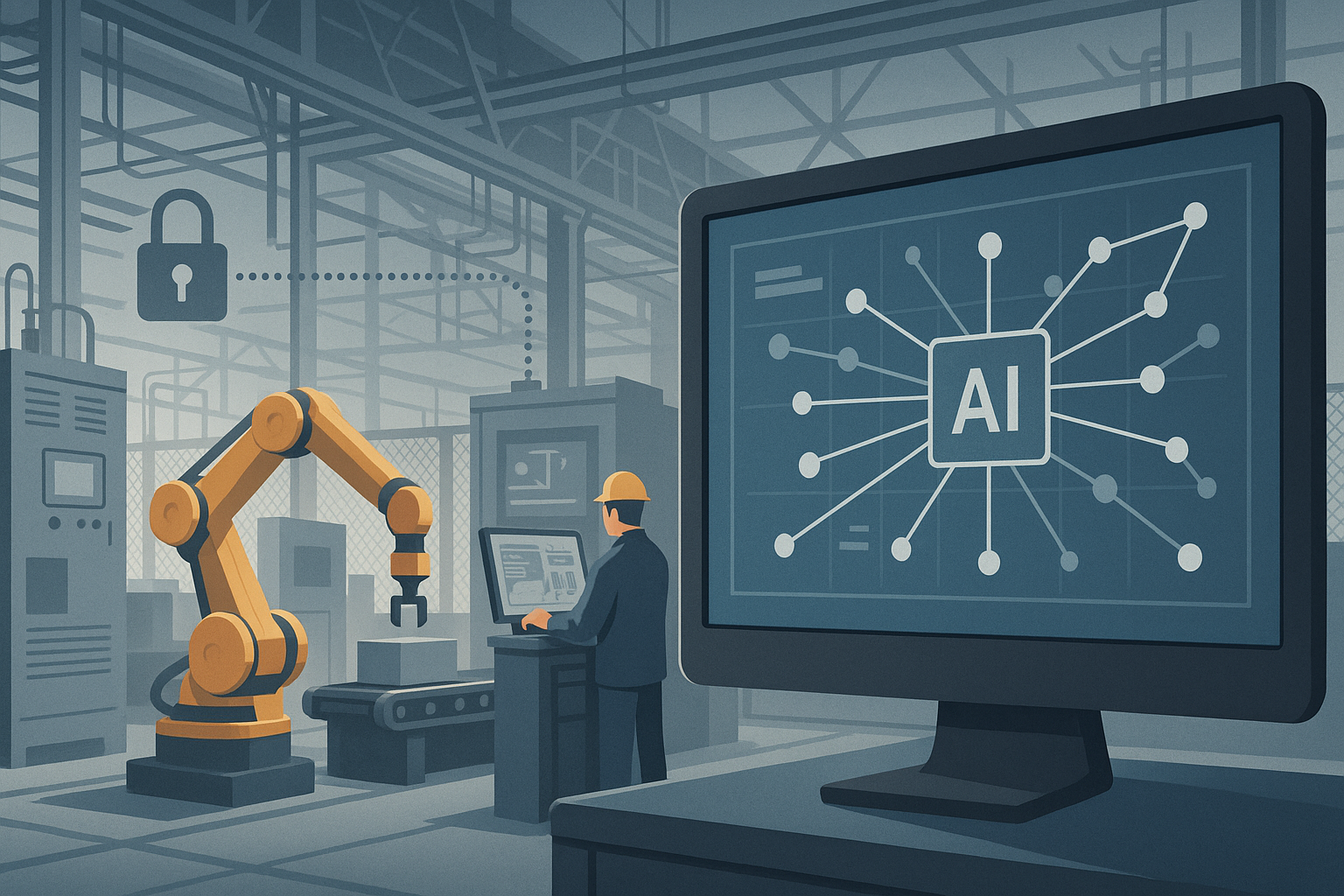
Industrial AI moves beyond pilots when manufacturers treat it like a production system, not a demo. In practical terms, that means tying the application to one business KPI, rebuilding the event record around that problem, launching in advisory mode, defining who approves what, and securing the data path before the tool is allowed into a live workflow (Automation.com, Aug. 25, 2026; Industrial Cyber, July 7, 2026).
“Beyond pilot” is the important distinction. A pilot can survive manual data cleanup, a small project team, and informal workarounds. Production use cannot. Once AI influences throughput, quality, maintenance, or operator action, it needs an owner, routine support, auditability, and a documented fallback when the model, the data feed, or the network fails (ISA, Industrial AI Position Paper, accessed Aug. 28, 2026).
What changes when AI enters production
Control Engineering’s August 2026 research reported that engineers are still moving cautiously and continue to favor proven use cases. That caution is rational. The step from pilot to production is not only a scale-up in compute or data volume; it is a shift in accountability. The AI application stops being an experiment and starts becoming part of the facility’s daily operating system (Control Engineering, Aug. 2026).
That shift changes the questions. During a pilot, the team asks whether the model can detect, predict, or classify. In production, the harder questions are operational: which data source is authoritative, how the recommendation is recorded, who can override it, and what the site does when an input arrives late or disappears. If nobody owns those answers, the project has not truly left the pilot stage.
Start with the event record
The first technical gate is not model choice. It is whether the site can reconstruct what happened around the problem it wants AI to solve. In plain language, that means building a dependable event record: machine state, operator actions, recipe or setpoint changes, material lot, quality result, alarm history, and timestamps. Automation.com called data readiness the missing link between operational technology (OT) data and scalable industrial AI, and Smart Industry made a similar case for a data-ops foundation (Automation.com, Aug. 25, 2026; Smart Industry, May 27, 2026).
That record often sits in pieces across the historian, the manufacturing execution system (MES), quality databases, and maintenance notes. If those pieces do not align, AI will struggle to distinguish a real anomaly from a normal startup, changeover, or upstream upset. The goal is not perfect enterprise data. It is enough context around one valuable problem to make the output credible and repeatable.
Consider a packaging line with intermittent seal defects. A vision model may detect the defect pattern, but the image alone may not explain it. The application may also need product code, film lot, jaw temperature, line speed, and the timing of the last changeover. The same principle applies in process operations: a temperature spike means something very different during startup than it does during steady-state production. In both environments, AI becomes more useful as the facility makes the event record more complete.
This is no longer a question only for the usual automation leaders. Automate.org reported that Q2 2026 robot orders increased as automation demand broadened across industries, which means more discrete manufacturers are now facing the same data and workflow questions as they add robotics, vision, and software-driven automation (Automate.org, Aug. 11, 2026).
Trust must live in the workflow
Operator trust does not come from a polished dashboard. It comes from a system that can show what it saw, how recent the information is, and why the recommendation fits the current operating state. Automation World made that point directly in August: industrial AI starts with trust (Automation World, Aug. 26, 2026).
For most plants, the first workable design is advisory AI. The system summarizes, ranks, predicts, or recommends, while the operator remains the decision maker. Just as important, the application should record whether the recommendation was accepted, modified, or rejected. That feedback loop improves the model, but it also gives operations a basis for confidence. A tool that asks for blind trust is hard to scale. A tool that shows its inputs and learns from operator response has a better chance.
Training matters here as much as analytics. Operators need to know what the system sees, what it does not see, and when it should be ignored. If the workforce experiences the application as a black box owned by someone else, it will remain a pilot no matter how well the original proof of concept performed.
Set decision rights early
A second gate appears once the first advisory use case works: how much authority, if any, should the AI receive? Suppliers are clearly pushing toward higher levels of autonomy, particularly in process operations. But a supplier roadmap is not the same thing as plant readiness. The safer progression is staged authority, with clear decision rights at each step (Automation.com, Aug. 24, 2026; Control Global, June 11, 2026).
A useful way to frame the issue is to ask five questions before the application gains deeper access: What can the system see? What can it recommend? What can it execute automatically? What still requires human approval? What happens when confidence drops or inputs are missing?
Those questions keep accountability visible. An AI tool may be allowed to prioritize inspection tasks or draft a maintenance work order long before it is allowed to make a bounded control move. Many facilities will also keep safety-critical actions outside AI discretion altogether. The important part is to document the operating envelope before the application begins influencing live decisions more aggressively.
Build security into the design
Security and governance cannot be bolted on after the use case is approved. Industrial Cyber reported in July 2026 that growing AI adoption in OT cybersecurity is exposing gaps in oversight, decision-making, and accountability. The same outlet also emphasized secure-by-design practices from concept through commissioning (Industrial Cyber, July 28, 2026; Industrial Cyber, July 7, 2026).
In practice, that means defining the data path between enterprise AI services and production systems, limiting privileges, logging recommendations and actions, controlling updates, and planning for degraded operation. If the AI service goes offline, the process still needs a predictable way to continue safely. If the application crosses IT and OT boundaries, identity, remote access, and change management need the same discipline applied to any other production-facing software (ISA, Industrial AI Position Paper, accessed Aug. 28, 2026).
Teams sometimes tolerate shared credentials, ad hoc connectors, or informal data exports during a proof of concept. Production systems should not. Once AI starts influencing operator behavior or process decisions, the interface becomes part of the control environment and deserves the same engineering discipline as the rest of the production stack.
Scaling is also an ownership problem
Data architecture and security matter, but scaling can fail for organizational reasons just as easily as technical ones. Moving beyond pilots changes who owns the result. Operations has to decide where recommendations fit into shift work. Controls has to validate interfaces and failure modes. Maintenance has to understand what happens when a sensor, tag, or model input disappears. Quality and regulatory teams may need to review how the output is recorded. Cybersecurity has to approve identities, connections, and update paths (ISA, Industrial AI Position Paper, accessed Aug. 28, 2026).
Someone also has to own the business outcome. If the use case is supposed to reduce scrap, cut changeover time, or prevent nuisance downtime, that KPI needs a named owner, not just a project champion. Otherwise the application may generate interesting insight without becoming part of routine decision-making. The system is not truly scaled until supervisors and operators know when to use it, when to override it, and how its performance will be reviewed over time.
A rollout sequence that travels well
As a practical synthesis, most manufacturers will be better served by a disciplined rollout than by a broad AI program launch.
1. Choose one KPI and one owner. Start with a problem tied to downtime, scrap, throughput, energy, or maintenance. Make one person accountable for the operating result, not just the installation.
2. Rebuild the event record around that problem. Align timestamps, labels, machine states, quality records, and operator notes so the system can reconstruct what happened with reasonable fidelity.
3. Add the missing context before adding more models. Connect raw OT data to production state, material information, and workflow history. In many early deployments, context adds more value than another algorithm.
4. Launch in advisory mode. Let the application recommend, explain, or prioritize. Use operator response to refine the workflow and expose blind spots before considering any automatic action.
5. Document approval rules, audit trails, and fallback behavior. Write down who can approve what, how overrides are recorded, and what the facility does when confidence drops or the AI service becomes unavailable.
6. Secure and support it like production software. Treat identities, segmentation, update control, logging, and lifecycle maintenance as part of the design, not as post-project cleanup (Automation.com, Aug. 25, 2026; Smart Industry, May 27, 2026; Industrial Cyber, July 7, 2026).
The industrial sector is not short on AI ideas. The harder challenge is making those ideas reliable at shift level. Lasting value is more likely when AI is legible to operators, accountable to production KPIs, and constrained by clear technical and governance boundaries.
Practical takeaway: before expanding any AI deployment, ask four questions. Do we have a reliable event record? Can operators see why the system is recommending this action? Are decision rights written down? Is the interface secure and supportable enough for daily use? If the answer is no to any of those, the next investment should probably go into readiness, not a larger model. In industrial AI, the breakthrough rarely comes from a flashier model. It comes from making the operation legible enough for software to help.
Sources consulted
- Automation.com — “Data Readiness: The Missing Link Between OT Data and Scalable Industrial AI” — Aug. 25, 2026 — https://www.automation.com/article/data-readiness-missing-link-between-ot-data-scalable-industrial-ai
- Automation.com — “Industrial AI Is Ready for More Authority. Operators Will Decide How Much It Gets.” — Aug. 24, 2026 — https://www.automation.com/article/industrial-ai-ready-more-authority-operators-decide-how-much
- Automation World — “Industrial AI Starts With Trust. Here’s How To Earn It.” — Aug. 26, 2026 — https://www.automationworld.com/analytics/news/55400956/industrial-ai-starts-with-trust-heres-how-to-earn-it
- Control Engineering — “Research: How industrial AI is impacting the plant floor.” — Aug. 2026 — https://www.controleng.com/research-how-industrial-ai-is-impacting-the-plant-floor/
- Smart Industry — “Why industrial AI requires a data ops foundation to scale.” — May 27, 2026 — https://www.smartindustry.com/artificial-intelligence/article/55379550/why-industrial-ai-requires-a-data-ops-foundation-to-scale
- ISA — “Industrial AI and Its Impact on Automation” Position Paper — accessed Aug. 28, 2026 — https://www.isa.org/getmedia/4493de53-c927-4c12-b804-baa9b8d8b9c4/Industrial-AI-Position-Paper.pdf
- Control Global — “Honeywell, Nvidia chart new path for industrial autonomy.” — June 11, 2026 — https://www.controlglobal.com/show-coverage/honeywell-users-group/article/55383664/honeywell-nvidia-chart-new-path-for-industrial-autonomy
- Industrial Cyber — “Growing AI adoption in OT cybersecurity exposes gaps in governance, oversight, decision-making accountability.” — July 28, 2026 — https://industrialcyber.co/features/growing-ai-adoption-in-ot-cybersecurity-exposes-gaps-in-governance-oversight-decision-making-accountability/
- Industrial Cyber — “Building secure industrial infrastructure requires secure-by-design principles from concept through commissioning.” — July 7, 2026 — https://industrialcyber.co/features/building-secure-industrial-infrastructure-requires-secure-by-design-principles-from-concept-through-commissioning/
- Automate.org — “Robot Orders Increase in Q2 as Automation Demand Broadens Across Industries.” — Aug. 11, 2026 — https://www.automate.org/market-intelligence/insights/robot-orders-increase-in-q2-as-automation-demand-broadens-across-industries