

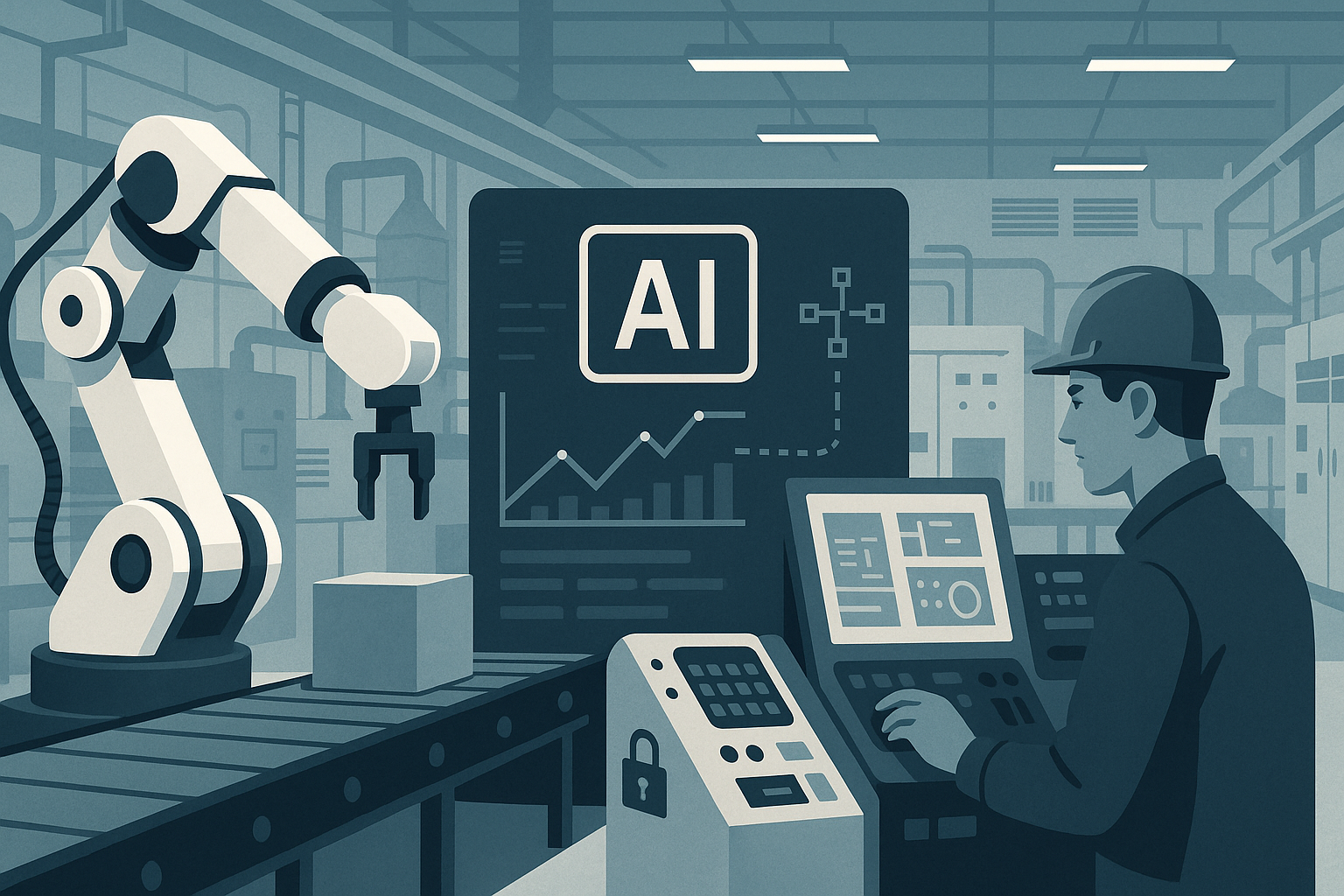
Manufacturers are no longer short on AI demonstrations. The harder question is what turns a promising proof of concept into something a plant can rely on every shift. For this article, scale does not mean “AI everywhere.” It means a use case can be repeated across similar assets, lines, cells, or units, tied to a measurable production, quality, maintenance, or energy KPI, and operated by the people who own the result.
A reasonable synthesis from 2026 industrial reporting is that repeatable deployment depends on four conditions: a specific operating problem, OT data that carries enough context to support action, a defined work process for using the output, and clear controls over access, approvals, and changes (Automation.com, Aug. 25, 2026; Automation World, July 13, 2026; Automation World, Aug. 20, 2026; Control Global, Sept. 2, 2026; Automation.com, May 26, 2026).
Proof of concept, pilot, and broader rollout are different stages. A proof of concept asks whether a model can detect a useful signal on historical or sample data. A pilot asks whether it works in live conditions. Broader rollout starts when the same pattern can be repeated without rebuilding the data pipeline, the operator workflow, and the control rules each time. That is where many efforts slow down (Machine Design, Jan. 6, 2026; IndustryWeek, June 10, 2026).
Industrial AI is usually ready to expand when four things are true: 1. The target is one measurable plant problem. 2. The data explains operating state, not just raw values. 3. The result lands inside a named daily work process. 4. The application has defined OT access, approval, and change controls.
Start with one measurable problem
Many teams still begin with the tool. The stronger starting point is a plant question with a named KPI: quality drift after changeovers, recurring nuisance trips on a pump train, rising compressed-air or steam use, or inspection bottlenecks on a packaging cell. Interviews and conference coverage this year repeatedly pointed to weak problem definition and unclear ownership as common reasons projects stall after the first live test (Control Global, Sept. 2, 2026; Machine Design, Jan. 6, 2026).
This does not mean every use case needs a full business case before the first trial. It does mean the plant should be able to say, in plain terms, what will improve if the application works and which team owns the result. If the expected outcome lives nowhere—not in OEE, scrap, downtime, yield, energy, or maintenance performance—it becomes hard to justify the engineering effort required for broader rollout. Report-based coverage from Smart Industry likewise suggested that manufacturers are being pushed to connect digital programs to operating results rather than open-ended experimentation, even though maturity still varies widely from one company to another (Smart Industry, May 19, 2026).
Make OT data usable
The data problem in manufacturing is usually not a shortage of signals. It is a shortage of usable context. A historian tag, alarm point, or machine variable has limited value on its own if the application cannot also see asset identity, operating mode, recipe or batch state, recent maintenance work, and the quality or production result that followed. That is why Automation.com framed data readiness as the missing link between OT data and scalable industrial AI (Automation.com, Aug. 25, 2026).
In many plants, the needed information already exists, but it is scattered across historians, PLC or DCS data, MES, CMMS, quality systems, and business applications. One-off connectors can support a pilot, but they become expensive to maintain when the same use case needs to move to the next line or unit. A common data foundation matters because repeatable deployment depends on consistent time stamps, asset naming, event definitions, and ownership across those systems (Automation.com, Aug. 25, 2026).
Operating state matters just as much as connectivity. A temperature spike during startup does not mean the same thing as the same spike at steady state. A quality shift after a raw-material change should not be interpreted the same way as a shift driven by tool wear or a recent operator adjustment. In practice, the data needs of discrete and process applications are closer than they first appear: a vision system on a line, a maintenance model on rotating equipment, and an advisory layer for a process unit all depend on time alignment, asset context, and clean connections to the systems where people will act (Automation World, July 13, 2026; Smart Industry, Aug. 21, 2026; Control Engineering, July 6, 2026; Control Global, Sept. 2, 2026).
Design for the person who must act
A useful model output is not yet an operational solution. The plant still needs to answer three practical questions: who sees the result first, what decision changes because of it, and where that action is recorded. If those answers are unclear, the application may be technically interesting but operationally fragile (Machine Design, Jan. 6, 2026; Control Global, Sept. 2, 2026).
The handoff should match the consequence. A low-risk inspection application might simply flag suspect product for review. A maintenance application might generate a ranked recommendation or draft work request. A higher-consequence process application may need to remain advisory, with the operator deciding whether to act. Those are illustrative patterns, but they reflect the bounded, workflow-centered direction emphasized in current reporting on manufacturing AI and industrial operations (Automation World, Aug. 20, 2026; Control Global, Sept. 2, 2026; Smart Industry, Aug. 21, 2026).
This is also where user confidence is built or lost. People are far more likely to adopt the tool when they know which inputs matter, how current the data is, what threshold or confidence rule is being used, and when human judgment should override the recommendation. Reporting on workforce buy-in this year made that point clearly: adoption is closely tied to whether the people nearest production see the system as understandable, useful, and safely bounded (Automation World, Aug. 20, 2026).
Set approval and OT security controls early
The risk profile changes as soon as AI stops being a stand-alone analytics layer and starts reading more plant systems, creating work orders, or influencing operating decisions. At that point, the application becomes part of the plant’s broader OT governance and resilience picture. Recent Industrial Cyber coverage has tied AI-in-OT discussions to system exposure, enterprise dependencies, resilience, and the operational consequences of giving new digital layers deeper reach into production environments (Industrial Cyber, Aug. 4, 2026; Industrial Cyber, Aug. 18, 2026).
ISA/IEC 62443 is not written specifically for AI, but its OT security disciplines apply directly to AI deployments. In practical terms, that means knowing which assets and interfaces are connected, limiting network reach through segmentation, assigning least-privilege access to users and service accounts, and putting connector, model, rule, and integration changes through documented change control. Those are not abstract policy items. They determine whether an AI layer can be updated, audited, and contained like the rest of the OT environment (Automation.com, May 26, 2026).
Plants should also decide early what the application can read, what it can write, and what it can only recommend. If the system can write back to another system—or even influence a decision with safety, quality, or uptime implications—the approval path and rollback method should be explicit before any broader rollout. That is especially important when AI outputs begin crossing the OT and enterprise boundary through ERP, maintenance, or quality platforms (Industrial Cyber, Aug. 4, 2026; Industrial Cyber, Aug. 18, 2026).
What repeatable deployment looks like
Real scale usually looks narrower and more disciplined than executive presentations suggest. A plant does not need enterprise-wide AI to claim success. Reusing one working pattern across a similar asset class, line family, or unit type is already meaningful scale if the data model, work process, and review logic stay largely intact. That definition is consistent with how trade reporting has framed the gap between experimentation and operational rollout (Automation World, July 13, 2026; Machine Design, Jan. 6, 2026; Control Global, Sept. 2, 2026).
A deployment is getting close to repeatable when it no longer depends on the original innovation team or outside specialist for daily use. Operations, maintenance, engineering, or quality should be able to run it, interpret it, and review its performance in the same cadence they use for other plant KPIs. The next line or unit should feel like a controlled extension of the first deployment, not a fresh invention.
That fits the direction of 2026 coverage across both discrete and process industries. On the discrete side, reporting around physical AI and robotics has emphasized practical, task-specific applications. On the process side, trade coverage has focused more on advisory and bounded optimization layers than on handing full control to a model. The common thread is repeatability and defined handoffs, not breadth for its own sake (Smart Industry, Aug. 21, 2026; Control Engineering, July 6, 2026; Control Global, Sept. 2, 2026).
A3’s Aug. 11 press update also reported that automation demand broadened across industries in Q2 2026, another sign that capital is still flowing to practical, bounded applications, even if order data alone does not measure AI maturity (A3 Press Center, Aug. 11, 2026).
Questions to ask before rollout
Before approving a broader rollout, plant teams should be able to answer five plain questions: - Which KPI is this application expected to improve? - Which data sources are required, and what operating-state context is included? - Who receives the result, in which system, and what action is expected? - What can the application read, what can it write, and who approves that step? - How will updates be tested, logged, and rolled back?
If those answers are still vague, the technology may be promising, but it is not yet ready for repeatable use (Automation.com, Aug. 25, 2026; Machine Design, Jan. 6, 2026; Automation.com, May 26, 2026).
Practical takeaway
The most useful lesson from this year’s industrial AI discussion is not that manufacturers should deploy more models. It is that they should standardize the conditions around the few use cases that matter most. In most plants, a short list of applications with clear data, clear owners, and clear limits will create more value than a broad portfolio of loosely governed experiments. When those basics are in place, AI can move from a successful trial to a dependable industrial tool. When they are not, broader rollout only spreads uncertainty (Automation World, Aug. 20, 2026; Automation.com, Aug. 25, 2026; Industrial Cyber, Aug. 18, 2026).
Sources consulted
- Automation World — “Scaling AI In Industrial Automation: 2026 Data On Workforce Buy-In” (Aug. 20, 2026): https://www.automationworld.com/factory/digital-transformation/article/55398393/parsec-scaling-ai-in-industrial-automation-2026-data-on-workforce-buy-in
- Automation World — “Why Industry 4.0 Still Hasn’t Scaled...and What Must Change” (July 13, 2026): https://www.automationworld.com/factory/digital-transformation/article/55390548/how-to-properly-scale-industry-40
- Automation.com — “Data Readiness: The Missing Link Between OT Data and Scalable Industrial AI” (Aug. 25, 2026): https://www.automation.com/article/data-readiness-missing-link-between-ot-data-scalable-industrial-ai
- Automation.com / ISA — “Certified Secure: Understanding ISA/IEC 62443 Certification Pathways” (May 26, 2026): https://www.automation.com/article/certified-secure-understanding-isa/iec-62443-certification-pathways
- Smart Industry — “Rockwell report: Days of ‘experimentation’ are over, DX is here to stay” (May 19, 2026): https://www.smartindustry.com/industry-news/news/55377451/rockwell-report-days-of-experimentation-are-over-dx-is-here-to-stay
- Smart Industry — “Physical AI: Where opportunity really sits—now, today—for manufacturers” (Aug. 21, 2026): https://www.smartindustry.com/artificial-intelligence/article/55399536/physical-ai-where-opportunity-really-sitsnow-todayfor-manufacturers
- IndustryWeek — “Designing the Future-Ready Factory” (June 10, 2026): https://www.industryweek.com/technology-and-iiot/emerging-technologies/article/55383242/designing-the-future-ready-factory
- Machine Design — “AI Adoption in Manufacturing: Future Tech’s Matt Scavetta on Avoiding Last-Mile Failures” (Jan. 6, 2026): https://www.machinedesign.com/automation-iiot/article/55340740/ai-adoption-in-manufacturing-future-techs-matt-scavetta-on-avoiding-last-mile-failures
- Control Global — “Why industrial AI adoption stalls and how to unstick it” (Sept. 2, 2026): https://www.controlglobal.com/show-coverage/ynow-a-yokogawa-users-conference/article/55402353/yokogawa-why-industrial-ai-adoption-stalls-and-how-to-unstick-it
- Control Engineering — “Control Engineering hot topics: June 2026” (July 6, 2026): https://www.controleng.com/control-engineering-hot-topics-june-2026/
- Industrial Cyber — “From Hype to Operational Reality: What We Learned at AI in OT Cyber” (Aug. 18, 2026): https://industrialcyber.co/features/from-hype-to-operational-reality-what-we-learned-at-ai-in-ot-cyber/
- Industrial Cyber — “Rethinking manufacturing cybersecurity as ERP and enterprise IT become critical to production continuity and resilience” (Aug. 4, 2026): https://industrialcyber.co/features/rethinking-manufacturing-cybersecurity-as-erp-and-enterprise-it-become-critical-to-production-continuity-and-resilience/
- A3 / Automate — Press Center, including “Robot Orders Increase in Q2 as Automation Demand Broadens Across Industries” (Aug. 11, 2026 listing consulted Sept. 3, 2026): https://www.automate.org/a3/press-center