

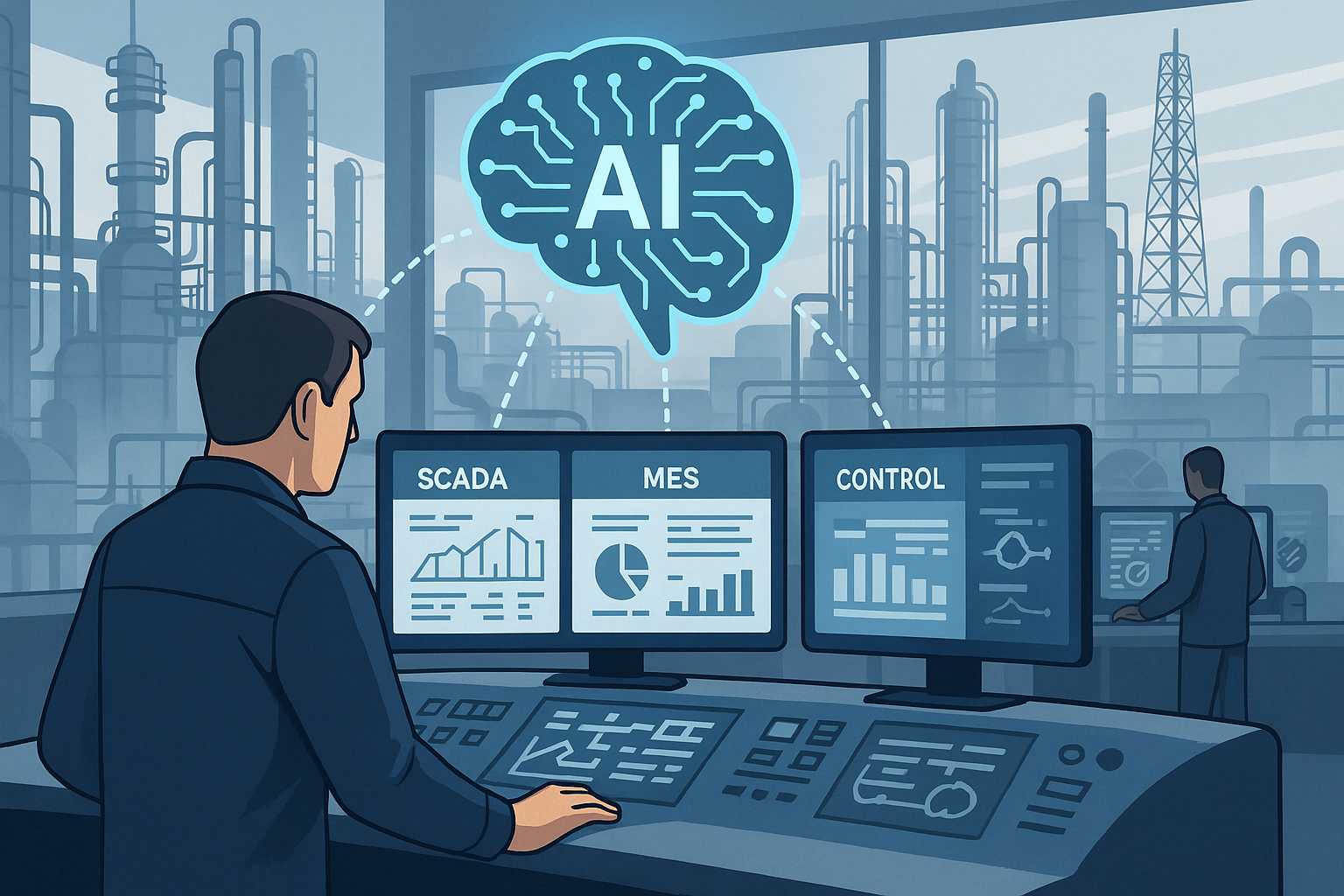
You do not need a greenfield project to get value from industrial AI. In an existing plant, the practical starting point is to leave the control system, SCADA, historian, and MES in place, let AI read the data those systems already produce, and return recommendations to operators, engineers, planners, or maintenance teams instead of writing directly into critical control. That staged approach aligns with recent industrial guidance emphasizing augmentation, lifecycle discipline, explainability, and governance (Automation World, Apr. 28, 2026; Control Engineering, Feb. 19, 2026; ISA, Nov. 6, 2025).
For this discussion, “AI” means first-phase tools such as anomaly detection, predictive maintenance models, quality prediction, operator assistants, and constrained optimization. It does not mean handing safety functions or tight closed-loop control to a general-purpose model on day one. Control Global’s recent discussion of agentic AI in process industries points in the same direction: plants are preparing by improving data and digital infrastructure before pushing deeper autonomy (Control Global, Apr. 15, 2026).
Start with readiness, not software
Before selecting a model or platform, find out whether the plant can support a clean data path. If tag names do not line up with asset names, if MES and maintenance records cannot be matched to historian timestamps, if vendor remote access is loosely controlled, or if nobody owns the data, fix that first. Smart Industry has argued that AI moves from promise to production only when the digital foundation is in place, and ISA’s industrial AI position paper puts cybersecurity, standards, and workforce readiness alongside the technical opportunity (Smart Industry, Dec. 26, 2025; ISA, Nov. 6, 2025).
There is also a clear limit case. If key plant systems are unsupported, if data cannot be reconciled across systems, or if operational changes cannot be audited, foundational modernization needs to come before an AI pilot. That is not a failure of AI. It is a sign that the plant still needs basic engineering discipline before it adds another layer of software.
SCADA discipline belongs in that readiness check. ISA announced publication of the ISA-112 standard for SCADA systems in February 2026, and Control Engineering’s review of the standard highlights lifecycle management, documentation, and change control as core SCADA practices (ISA, Feb. 24, 2026; Control Engineering, Apr. 17, 2026). Once AI starts consuming alarms, events, and operator actions from SCADA, those practices become part of model reliability.
Where AI should sit in the stack
The simplest way to think about first-phase AI is as a sidecar to the automation stack, not a replacement for it. Existing PLC or DCS logic continues to run the process. SCADA and HMIs remain the main operator interface. The historian keeps collecting time-series data. MES keeps handling production context. The AI layer sits beside those systems, pulls approved data through existing interfaces, and turns that data into recommendations.
In practice, that architecture has four parts:
- Keep control and safety functions in the existing automation system.
- Pull only the needed data from approved sources such as the historian, SCADA event and alarm records, MES, CMMS, or ERP.
- Run the model in a managed analytics environment at the edge or in IT/cloud infrastructure.
- Send the result back as an advisory, ranked exception, or suggested action inside an existing plant workflow.
That pattern fits the IT/SCADA convergence now being discussed in industrial automation, but it avoids turning the first AI project into a control migration (Automation World, Apr. 27, 2026; Control Engineering, Feb. 19, 2026).
The key design choice is what not to do. In early phases, avoid letting AI write directly into critical control logic. Let it recommend. Let an operator, engineer, or an existing rule-based application decide whether to act. That keeps the control boundary clear while the plant learns what the model is good at and where it still needs refinement.
Build the minimum context layer
A historian gives you signals. It does not give you context.
For a model to be useful, it usually needs to know more than temperature, pressure, speed, or vibration. It may also need asset identity, operating mode, product or recipe, lot genealogy, maintenance state, alarm state, and the final quality outcome. That context is often scattered across systems. The practical move is not to launch a giant enterprise data project. It is to assemble the smallest reliable context layer needed to answer one operational question.
That is where many AI projects become real plant projects rather than software experiments. A quality model may need MES and lab results as much as historian trends. A maintenance model may need work-order history and failure coding, not just vibration data. IndustryWeek’s recent case for cross-functional AI and Control Engineering’s lifecycle-ready AI coverage both point to the same lesson: the value often appears at the handoff between operations, maintenance, quality, and planning, not inside one isolated application (IndustryWeek, Mar. 13, 2026; Control Engineering, Feb. 19, 2026).
A quick brownfield example
Consider a packaging line with recurring seal-quality drift after changeovers. The plant already collects jaw temperature and pressure in the historian, alarms in SCADA, recipe and lot data in MES, and maintenance notes in CMMS. Nothing about that setup needs to be replaced to test a useful AI application.
The plant adds an analytics layer that looks for the pattern that usually appears before rejects increase. When that pattern appears, the supervisor sees an advisory in the line-performance view, MES attaches the warning to the active lot, and maintenance receives a suggested inspection task for the next scheduled stop. Operators can confirm, reject, or comment on the recommendation, and the team reviews whether the alert actually reduced scrap or prevented downtime.
That is what a workable first integration looks like. Existing systems stay in place. The model reads across them, adds context, and feeds guidance back into the plant without taking over the machine.
Put the output where people already work
A recommendation buried in a stand-alone dashboard is easy to ignore. A recommendation that arrives inside the daily workflow has a much better chance of being used and improved.
That means maintenance guidance should feed maintenance planning. Quality risk should appear where production or quality teams already review lots, batches, and exceptions. Operator guidance should be visible in the operating context, not in a separate analytics portal that requires another login and another interpretation step. IndustryWeek’s argument that the biggest productivity gains will come from cross-functional AI matters here: the handoff path is part of the use case, not an afterthought (IndustryWeek, Mar. 13, 2026).
This is also where many brownfield projects either gain traction or stall. If the plant cannot say who receives the recommendation, how the action is approved, and where the result is recorded, the integration is still incomplete.
Treat governance and cybersecurity as design requirements
Every AI connection creates new identities, data paths, and potential attack surfaces. ISA’s position paper highlights cybersecurity, standards, and explainability as central industrial AI issues, while Control Global and Industrial Cyber have both stressed zero-trust thinking and integrated cyber strategy as plants add more digital tools and remote connectivity (ISA, Nov. 6, 2025; Control Global, Dec. 4, 2025; Industrial Cyber, Dec. 14, 2025).
In practical terms, that means deciding a few things before the pilot starts. Who can change model logic, thresholds, or prompt templates? Who approves a new data source? Where does plant data cross from OT to IT or cloud infrastructure? How are outputs logged for audit and review? What happens if the model is unavailable or produces a poor recommendation?
Explainability belongs here too. ISA’s guidance puts real weight on it, and in plant terms that means a recommendation should show its basis clearly enough for a human to judge it: what variables drove the alert, what operating range it applies to, and what action it is actually suggesting (ISA, Nov. 6, 2025). If the model cannot make its case in a way the plant can review, it is not ready for production use.
A rollout sequence that fits legacy plants
A disciplined rollout usually looks like this:
- Pick one KPI and one recurring decision.
- Identify the smallest set of data sources needed, and assign ownership for each one.
- Keep the first connection to control and safety systems read-only or tightly gated.
- Return the result to an existing workflow such as MES, maintenance planning, shift review, or an advisory panel in SCADA.
- Log recommendations, overrides, and outcomes so operations, maintenance, and engineering can review them.
- Expand only after the first use case improves a measurable metric and can be supported securely.
If the plant gets stuck at step two because the data is inconsistent or ownership is unclear, that is useful information. It means the next project should be data cleanup, interface cleanup, or lifecycle modernization, not a bigger AI pilot.
The main point is simple: AI does not have to replace the automation stack to be useful. In many brownfield plants, the better first move is to make existing control, SCADA, historian, and MES systems more valuable by adding a well-governed analysis layer on top of them. If the plant has trusted data, clear ownership, and sound cyber discipline, that can happen without rip-and-replace. If those basics are missing, do the cleanup first.
Sources consulted
- Automation World, “Augment, Don’t Replace: The New Playbook for AI in Industrial Automation” (Apr. 28, 2026)
- https://www.automationworld.com/factory/digital-transformation/article/55372960/augment-dont-replace-the-new-playbook-for-ai-in-industrial-automation
- Automation World, “The Convergence of IT and SCADA: A New Model for Industrial Automation Development” (Apr. 27, 2026)
- https://www.automationworld.com/control/article/55373301/control-system-integrators-association-csia-the-convergence-of-it-and-scada-a-new-model-for-industrial-automation-development
- Control Engineering, “Lifecycle-ready AI: unlocking value at every stage of process manufacturing” (Feb. 19, 2026)
- https://www.controleng.com/lifecycle-ready-ai-unlocking-value-at-every-stage-of-process-manufacturing/
- Control Engineering, “Tutorial: Inside look at the ISA112 SCADA lifecycle standard” (Apr. 17, 2026)
- https://www.controleng.com/tutorial-inside-look-at-the-isa112-scada-lifecycle-standard/
- Automation.com, “News & Articles for Industrial Automation Professionals” (accessed Apr. 30, 2026)
- https://www.automation.com/articles-and-news
- Smart Industry, “Crystal Ball 2026: The year AI moves from promise to production” (Dec. 26, 2025)
- https://www.smartindustry.com/special-reports/article/55337079/crystal-ball-2026-the-year-ai-moves-from-promise-to-production
- ISA, “ISA Explores Industrial AI’s Impact on Automation in a New Position Paper” (Nov. 6, 2025)
- https://www.isa.org/news-press-releases/2025/november/isa-explores-industrial-ai-s-impact-on-automation
- ISA, “ISA Announces Publication of New Standard for SCADA Systems” (Feb. 24, 2026)
- https://www.isa.org/news-press-releases/2026/february/isa-announces-publication-of-new-standard-for-scad
- IndustryWeek, “The Big Productivity Gains Will Come from Cross-Functional AI” (Mar. 13, 2026)
- https://www.industryweek.com/technology-and-iiot/digital-tools/article/55363960/the-big-productivity-gains-will-come-from-cross-functional-ai
- Machine Design, “AI Takes Center Stage at Hannover Messe 2026 Preview” (Feb. 26, 2026)
- https://www.machinedesign.com/markets/robotics/article/55360353/ai-takes-center-stage-at-hannover-messe-2026-preview
- Automate.org, “Inside the Factory of the Future: AI, Robotics, and Software-Defined Automation” (Feb. 25, 2026)
- https://www.automate.org/ai/whitepapers/inside-the-factory-of-the-future-ai-robotics-and-software-defined-automation
- Control Global, “Setting up for agentic AI” (Apr. 15, 2026)
- https://www.controlglobal.com/control/ai-ml/article/55371089/setting-up-for-agentic-ai-processing-industries-tackle-artificial-intelligence
- Control Global, “Zero-trust, AI and other new tools nose into cybersecurity” (Dec. 4, 2025)
- https://www.controlglobal.com/protect/cybersecurity/article/55336310/zero-trust-ai-and-other-new-tools-nose-into-operational-technology-cybersecurity
- Industrial Cyber, “2026 and beyond: Urgent need for integrated cybersecurity strategies in evolving industrial landscape” (Dec. 14, 2025)
- https://industrialcyber.co/features/2026-and-beyond-urgent-need-for-integrated-cybersecurity-strategies-in-evolving-industrial-landscape/