

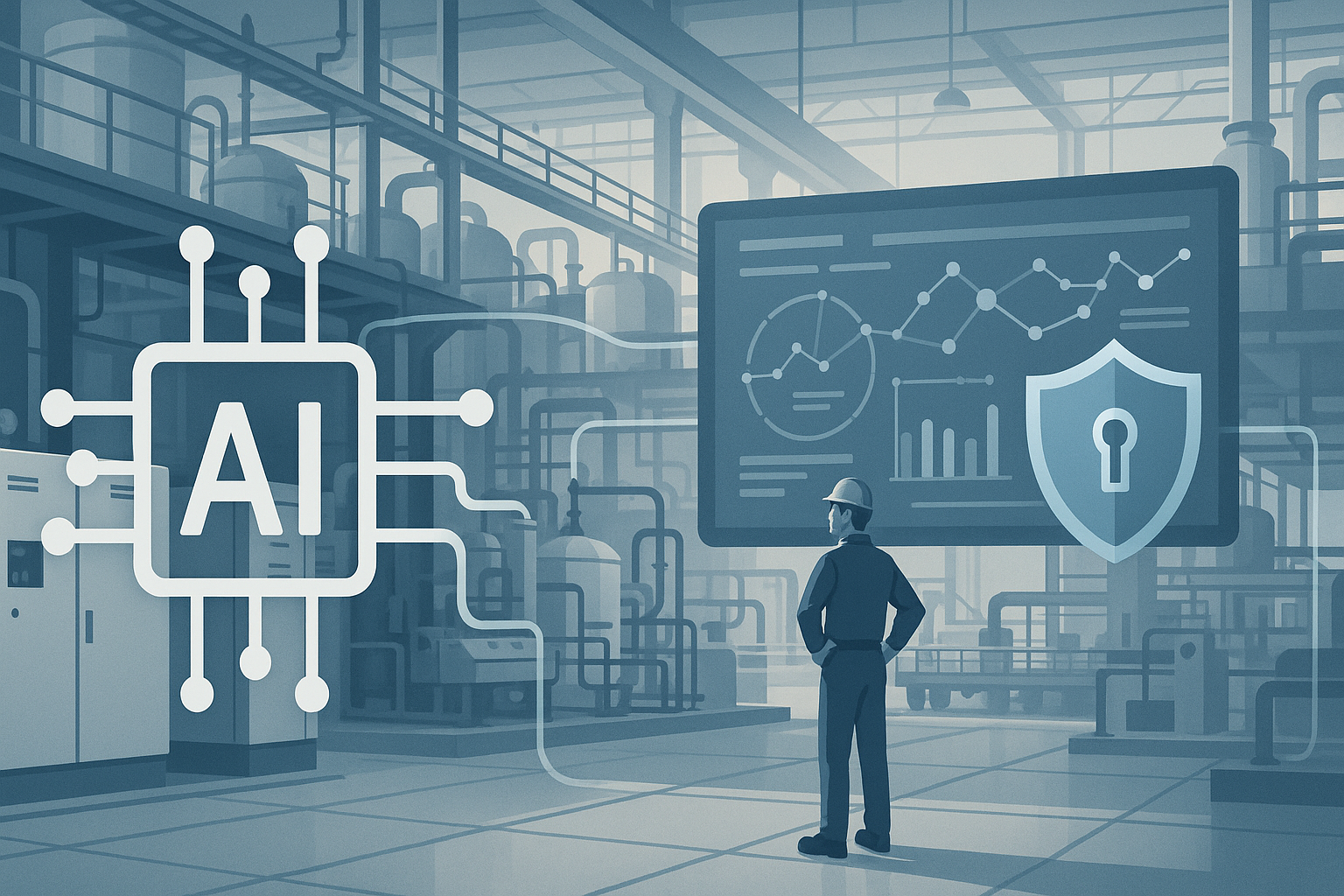
Industrial AI is no longer a novelty problem. It is a deployment problem.
Control Engineering’s latest research found 65% of organizations are piloting or evaluating AI/ML for automation and controls, yet 61% reported low or no trust in AI-driven control systems (Control Engineering, Aug. 7, 2026). That qualifier matters: the survey is pointing specifically to trust in AI influencing control decisions, not to every use of AI in manufacturing. Even so, it helps explain why many plants can demonstrate value in a pilot and still hesitate when it is time to extend that application to another line, unit, or site (Automation.com, July 23, 2026).
The path beyond the pilot is usually less dramatic than the hype suggests. Plants that scale industrial AI tend to do four things before they widen deployment: choose a narrowly defined use case, build plant context around the data, assign clear ownership, and review the OT architecture as seriously as the model itself (Smart Industry, May 27, 2026; IndustryWeek, Sept. 1, 2026; Industrial Cyber, July 28, 2026).
In industrial settings, trust is the result of those disciplines. If a team can explain where the data came from, what the model is allowed to influence, who approves action, and how the workflow fails safely, scale becomes an engineering decision. If it cannot, the pilot usually remains a demo.
A pilot proves the model. Scale proves the workflow.
A pilot can show that an algorithm detects anomalies, predicts a failure, or classifies an image on a known set of equipment. A broader rollout asks harder questions. Does the same data exist on comparable assets? Are naming conventions consistent? Will maintenance respond the same way on each shift? Is there a standard method for reviewing false positives, updating the model, and documenting changes?
That is where many programs slow down. Recent coverage on stalled Industry 4.0 initiatives has pointed to the same underlying issue: technology does not scale on its own. Ownership, integration, and process change do (Automation World, July 13, 2026). AI exposes that gap quickly because a good prediction is worthless if the plant cannot act on it consistently.
Consider a bearing-health model on one motor. The model may correctly flag rising risk. The plant still has work to do: map the alert to the correct asset, connect it to maintenance history, judge production impact, confirm parts availability, and define who decides whether to inspect, defer, or shut down. That is not model science. That is operational design.
Start where the output can be checked
For a first rollout, the best use cases share a few traits. They have a narrow objective, known inputs, a measurable result, and a human who can verify whether the output makes sense.
Predictive maintenance fits that filter well, which helps explain why it was the leading active AI/ML application in Control Engineering’s automation and controls research (Control Engineering, Aug. 7, 2026). The data sources are familiar, the failure modes are usually understandable, and the recommendation can be checked against inspections, vibration trends, repair history, and avoided downtime.
Inspection and machine vision are often good second candidates for the same reason. If a model flags a surface defect, label issue, or dimensional concern, a quality engineer can compare that result against established defect criteria. The output is observable, the business case is usually direct, and model improvement can be tied to labeled examples instead of vague impressions.
Operator support is another practical lane when plants use AI to retrieve procedures, summarize past alarm or maintenance notes, or surface troubleshooting context faster. That approach fits the recent industrial guidance to use AI as an augmentation layer for experienced personnel rather than as a substitute for them (Automation World, Apr. 28, 2026). It also addresses a problem IndustryWeek has emphasized: AI only becomes useful on the plant floor when it understands factory context instead of generating generic answers (IndustryWeek, Sept. 1, 2026).
For most plants, high-consequence closed-loop control and safety instrumented functions should stay out of the first wave. Industrial Cyber has been explicit that plants should not place AI into direct control of PLCs, HMIs, DCSs, or safety systems without strong governance, oversight, and accountability (Industrial Cyber, July 28, 2026). For many facilities, the safer early pattern is advisory: detect, explain, recommend, and let operations decide.
When a pilot becomes a program, the job changes
The step from one pilot to a broader rollout is where many teams underestimate the work. A pilot can survive on local expertise and manual cleanup. A multi-line or multi-site program cannot.
First, a scaled AI application needs a named operational owner. That owner does not have to build the model, but someone in operations, maintenance, or engineering must own the decision the model is influencing. IT and data teams can support the platform. They should not be the only people accountable for whether the workflow improves uptime, quality, or response time.
Second, the plant needs a repeatable template. That includes the asset definition, the data mapping, the alert thresholds, the response procedure, and the KPI. If one site treats a “high risk” alert as inspect this shift and another treats it as plan for the next outage, the algorithm may be identical while the business outcome is not.
Third, broader deployment requires lifecycle discipline. Plants need version control, retraining or revalidation triggers, false-positive review, and a way to detect model drift when operating conditions change. As AI systems become more capable of acting across connected tools, governance and accountability demands increase with them, not decrease (Automate.org, Aug. 12, 2026). That is especially important when product mix, sensor condition, or operating envelopes shift over time.
Finally, scaling requires change management. Operators have to know what the model is telling them, maintenance has to know how to respond, and engineering has to know when to adjust or retire the application. Recent coverage from Automation World and Smart Industry has kept returning to the same point: digital initiatives stall when the surrounding work process is left informal (Automation World, July 13, 2026; Smart Industry, May 27, 2026).
DataOps is how raw signals become plant context
Smart Industry’s recent argument that industrial AI needs a DataOps foundation is worth translating into plant language. DataOps is the discipline of preparing, contextualizing, governing, and delivering data so engineers, operators, applications, and analytics are working from the same version of the truth (Smart Industry, May 27, 2026).
That matters because AI-ready data is not just more tags in a historian. It is data that is time-aligned, tied to the right asset, labeled by operating state, and connected to the surrounding work history. IndustryWeek framed the challenge plainly: the real task is making AI understand the factory (IndustryWeek, Sept. 1, 2026).
If vibration data is separated from asset hierarchy, batch or recipe context, work orders, and quality outcomes, a model may still return a score. What it cannot return is a decision the plant will readily trust. Data context is what turns a pattern into an action.
Use OT architecture to set the safe boundary
Recent OT security coverage has been consistent on one point: an AI application should be treated like any other OT-connected system, with defined trust boundaries, access rules, and monitoring (Control Global, June 26, 2026; Industrial Cyber, July 28, 2026).
ISA/IEC 62443 is useful here less as a compliance slogan than as design discipline. In practical terms, plants should ask which zone the application belongs in, how data moves in and out, which accounts can change the model or its connectors, what activity is logged, and how updates are approved (ISA position paper, accessed Sept. 6, 2026; Control Global, June 26, 2026).
That architecture review matters before expansion, not after it. If a pilot depends on broad flat-network access, unmanaged third-party connections, or unclear model-update paths, widening deployment only multiplies the risk. The same goes for any application that can influence production decisions without a clear audit trail.
This boundary work becomes more important as OT teams evaluate agentic AI. Automate.org recently described agentic systems as software that can plan and execute multistep actions across tools, while also highlighting the governance and risk questions that come with that added autonomy (Automate.org, Aug. 12, 2026). In industrial environments, that is a reason to tighten control boundaries, not relax them.
Keep human approval in the first wave
Recent industrial AI guidance has leaned toward augmentation rather than replacement (Automation World, Apr. 28, 2026). Human-in-the-loop design is not a temporary compromise. It is a sensible operating model for early and mid-stage deployments.
For most plants, a practical sequence is to let AI detect, summarize, classify, or recommend before asking it to trigger higher-consequence actions. A maintenance planner can review an anomaly alert. A quality engineer can confirm a suspect classification. A control room should be much more cautious about allowing an AI application to change setpoints or permissives.
Human oversight belongs closest to the use cases where a wrong output can create safety, environmental, quality, or production risk. The goal is not to slow adoption. The goal is to let the plant learn where the model is dependable, where it drifts, and where the workflow needs tighter boundaries.
A five-point test before you expand deployment
Before extending an AI application beyond the original pilot area, plant teams should be able to answer five questions:
1. Is the next target truly comparable? The second asset, line, or site should have similar instrumentation, operating conditions, and response logic. Otherwise you are starting a new project, not scaling the first one.
2. Is the data contextualized, not just collected? Time stamps, asset mapping, operating state, and related work history should line up well enough that the output can be explained to operations and maintenance.
3. Is there a named business owner? Someone in operations, maintenance, or engineering should own the KPI and the response workflow, not just the software stack.
4. Has OT architecture been reviewed for the wider rollout? Network zone placement, access control, logging, update approval, and fallback procedures should be defined before new connections are added.
5. Can the team detect drift and fail safely? The plant should know how it will spot degrading model performance, who can pause or roll back the application, and what manual method replaces it when needed.
Industrial AI will scale in manufacturing, but not because plants found a better demo. It will scale when the surrounding discipline becomes repeatable.
The real milestone is not the first model that works. It is the first AI workflow the plant can explain, secure, monitor, and reproduce without heroics. When that foundation is in place, broader deployment becomes practical. When it is missing, buying a larger model usually just creates a larger pilot.
Sources consulted
- Automation World — “Why Industry 4.0 Still Hasn’t Scaled...and What Must Change” — July 13, 2026
- https://www.automationworld.com/factory/digital-transformation/article/55390548/how-to-properly-scale-industry-40
- Automation World — “Augment, Don’t Replace: The New Playbook for AI in Industrial Automation” — Apr. 28, 2026
- https://www.automationworld.com/factory/digital-transformation/article/55372960/augment-dont-replace-the-new-playbook-for-ai-in-industrial-automation
- Automation.com — “Can AI Be Trusted in Industrial Automation?” — July 23, 2026
- https://www.automation.com/article/ai-trusted-industrial-automation
- Smart Industry — “Why industrial AI requires a data ops foundation to scale” — May 27, 2026
- https://www.smartindustry.com/artificial-intelligence/article/55379550/why-industrial-ai-requires-a-data-ops-foundation-to-scale
- Control Engineering — “Research: How industrial AI is impacting the plant floor” — Aug. 7, 2026
- https://www.controleng.com/research-how-industrial-ai-is-impacting-the-plant-floor/
- IndustryWeek — “How Do We Make AI Understand Our Factory?” — Sept. 1, 2026
- https://www.industryweek.com/technology-and-iiot/emerging-technologies/article/55402222/how-do-we-make-ai-understand-our-factory
- IndustryWeek — “State of the Market 2026: How Industrial DataOps and AI-Ready Data are Reshaping Manufacturing” — Aug. 6, 2026
- https://www.industryweek.com/webinars/webinar/55385438/state-of-the-market-2026-how-industrial-dataops-and-ai-ready-data-are-reshaping-manufacturing
- Automate.org / A3 — “Agentic AI in OT: New Capabilities, Emerging Risks, and Governance Challenges” — Aug. 12, 2026
- https://www.automate.org/ai/editorials/agentic-ai-in-ot-new-capabilities-emerging-risks-and-governance-challenges
- Control Global — “Can processes stay secure as AI emerges?” — June 26, 2026
- https://www.controlglobal.com/network/industrial-networks/article/55386930/isas-sunil-doddi-shares-how-industrial-control-processes-can-stay-secure-as-ai-emerges
- Industrial Cyber — “Growing AI adoption in OT cybersecurity exposes gaps in governance, oversight, decision-making accountability” — July 28, 2026
- https://industrialcyber.co/features/growing-ai-adoption-in-ot-cybersecurity-exposes-gaps-in-governance-oversight-decision-making-accountability/
- Industrial Cyber — “The State of AI in OT Cybersecurity 2026”
- https://industrialcyber.co/view/the-state-of-ai-in-ot-cybersecurity-2026/
- ISA — “Industrial AI and Its Impact on Automation” — position paper, accessed Sept. 6, 2026
- https://www.isa.org/getmedia/4493de53-c927-4c12-b804-baa9b8d8b9c4/Industrial-AI-Position-Paper.pdf