

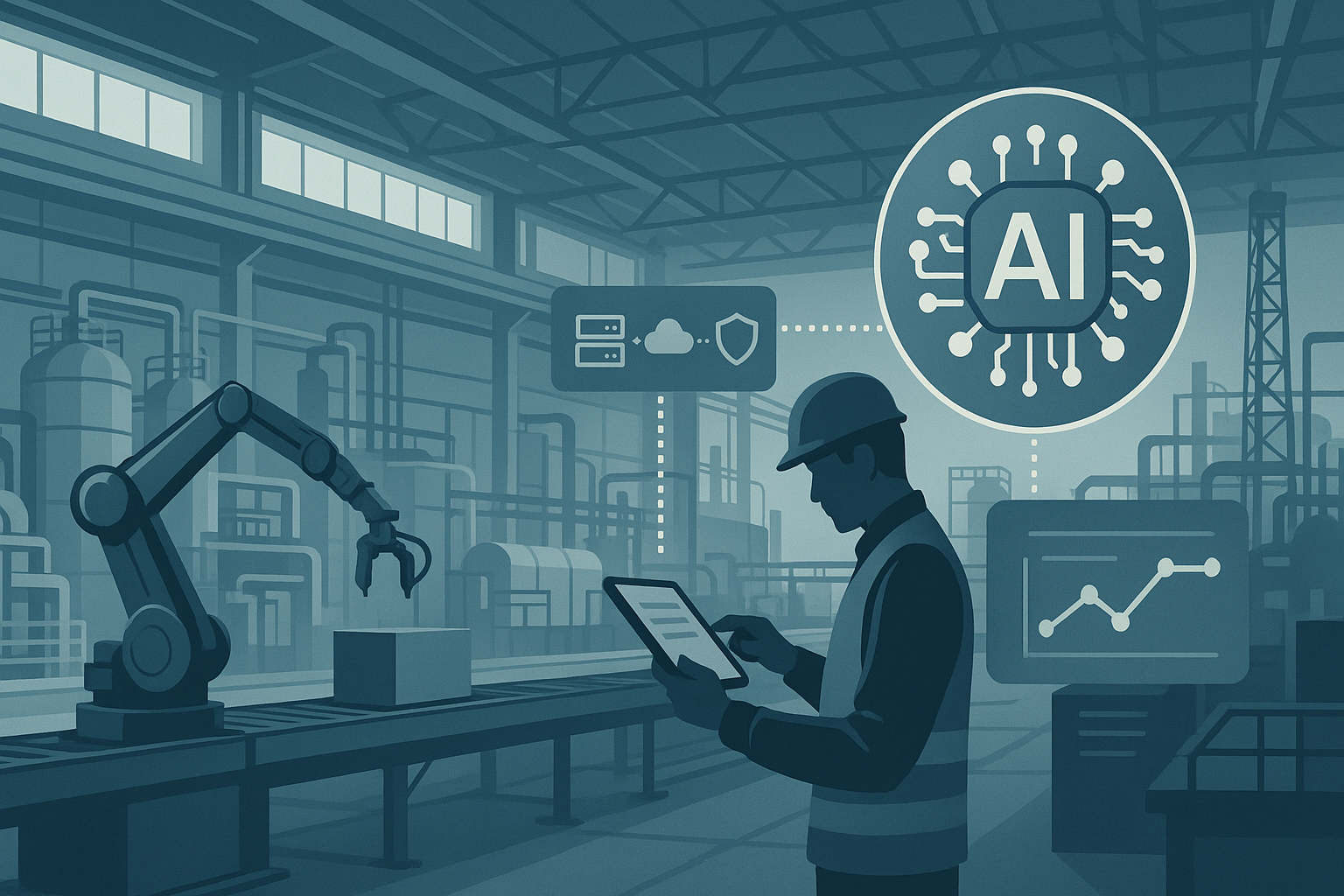
Most manufacturers do not need a greenfield reset to start using industrial AI. In an existing plant, the more realistic path is to begin with one KPI-based use case, connect the data already trapped in legacy systems, and standardize the data, integration, workflow, and security pieces that let the first success spread to similar assets, lines, or sites. Recent coverage in Smart Industry, Automation World, Control Global, Automation.com, and Control Engineering keeps returning to the same execution problem: AI initiatives stall less from a lack of algorithms than from weak data context, fragmented architectures, unclear ownership, and unmanaged cyber risk (Smart Industry; Automation World; Control Global; Automation.com; Control Engineering).
Smart Industry has described industrial AI as entering an “application phase.” That is a useful shorthand, but existing plants still need a scaling strategy, not just a pilot. A pilot proves that a model can produce an answer on one problem. Scaling means the plant can repeat the method without redesigning the control environment for each new asset, line, or site.
What Scaling Means in an Existing Plant
Established plants start from a very different position than greenfield sites. Brownfield modernization coverage in Smart Industry, Automation.com, and Control Engineering repeatedly centers on mixed control environments: PLCs, DCS or SCADA platforms, historians, HMIs, quality systems, maintenance systems, and years of site-specific naming conventions. Smart Industry has also been direct that full rip-and-replace programs are often financially unrealistic, while Automation.com and Control Engineering have highlighted middleware, open APIs, and modular automation approaches as more practical bridges (Smart Industry; Automation.com; Control Engineering).
Avoiding a wholesale replacement does not make the work light. Tag cleanup, connector setup, network design, asset modeling, workflow changes, and cyber review are still required. The difference is sequencing. Instead of replacing controls just to make data accessible, plants can often add a layer around existing systems that exposes data, preserves control stability, and creates a usable path to AI.
Two terms matter here. Contextualized data means plant data tied to the conditions that give it meaning: asset identity, timestamps, operating state, product or recipe, batch or lot, and related maintenance or quality events. An overlay architecture means the edge connectors, historians, middleware, APIs, and data services that sit around legacy controls so information can be collected and routed without rewriting the basic control logic.
- Choose a First Use Case That Is Worth Repeating
The first project should solve a real plant loss, but it should also be repeatable. That is the difference between starting and scaling.
A narrow use case tied to one KPI and one owner is still the best entry point. Smart Industry’s coverage of failed industrial AI pilots makes that clear, and IndustryWeek’s reporting on TE Connectivity’s AI kaizens reinforces the value of putting AI inside a continuous-improvement process rather than outside it (Smart Industry; IndustryWeek). For an existing plant, though, the better question is not only “Will this pilot work?” It is also “If it works, where else can the same method be used?”
Good starting points usually involve repeated asset classes or repeated operating problems. A pump or compressor health model that can be reused across multiple units is more scalable than a one-off application built around a single unusual machine. The same logic applies to packaging-line changeover variation, reject analysis tied to repeated product families, or energy-intensity monitoring across similar process units. If the first project depends on unique data structures, unique workarounds, and a unique decision path, the plant may end up with a successful pilot and no scalable program.
Before work begins, the team should be able to answer four practical questions: Which KPI is expected to move? Who owns the decision? What action follows the model output? Which similar assets, lines, or cells would use the same pattern next? Those answers turn a pilot idea into a deployment template.
- Define the Data Context the Model Actually Needs
Once the use case is chosen, the next job is not to collect more data. It is to define what the data must mean.
Automation World and Control Global both emphasize readiness, and Machine Design’s recent focus on data flow reinforces the same point: raw signals are not enough if the plant cannot interpret them consistently (Automation World; Control Global; Machine Design). A temperature value without operating state, a vibration reading without asset identity, or a quality result without product context may help an experienced engineer reviewing an incident. It is far less useful to an AI system expected to support decisions at scale.
In practical terms, data context usually includes consistent timestamps, a stable asset hierarchy, operating-state labels such as startup or steady state, links to product or batch information where relevant, and links to maintenance, alarm, and quality events that explain why a value matters. In discrete manufacturing, that may mean aligning PLC data, vision rejects, and work-order history around a common machine or product model. In a process environment, it may mean aligning historian data with lab results, alarms, operating modes, and maintenance notes.
This is one of the most underestimated parts of brownfield AI. In many existing plants, the signals exist but the structure around them does not. Tag normalization, state models, time synchronization, master-data cleanup, and exception handling rarely attract much attention, but they are what turn scattered plant data into usable AI inputs.
- Add an Integration Layer Around Legacy Controls
Data context answers what the data means. The next question is how the data moves.
Automation.com’s middleware and interoperability coverage, including its reporting on CESMII’s i3X open API work, points to a growing emphasis on more standard ways to exchange manufacturing data. Control Engineering’s reporting on open process automation and software-defined automation points in the same direction: plants want more flexible ways to connect existing control assets to newer digital services without destabilizing production (Automation.com; Control Engineering).
That is where the overlay architecture earns its keep. In an existing plant, the first scalable AI rollout is often better handled as a secure integration layer around the control environment than as a direct change to control logic. That layer can pull data from PLCs, DCS or SCADA systems, historians, inspection systems, MES platforms, CMMS tools, or lab systems, then route that data to analytics and back into the systems people already use.
In a packaging plant, the layer may connect PLC tags, vision data, reject counts, and changeover records. In a process plant, it may connect historian records, lab values, alarms, and asset-management data. In both cases, the goal is the same: make data accessible and reusable without forcing a controls rewrite before value is proven.
Middleware is not a shortcut around engineering discipline. Each connector, mapping rule, API, and network path has to be maintained. The benefit is not that the work disappears. The benefit is that the work can be reused across multiple use cases instead of being recreated from scratch with every project.
- Standardize the Pieces That Make Rollout Repeatable
This is the step that most determines whether one project becomes a program.
A plant has not scaled AI when one model works on one line. It has scaled when the second, third, and tenth deployment require less custom work than the first. That only happens when the plant standardizes the pieces that should not change.
Those reusable pieces usually include naming conventions, asset hierarchies, connector patterns, API rules, and security baselines. They also include KPI definitions, model-validation steps, alert or work-order logic, and a simple governance model for who monitors performance, adjusts thresholds, and retires stale use cases. Automation World’s recent reporting on the human factor is useful here because repeatability is not only technical. Teams also need a common process for reviewing model outputs, approving changes, and deciding when a use case is ready to move from one line or unit to another (Automation World).
This is where interoperability work starts paying back. If one site creates a clean asset model and a stable integration pattern for a compressor fleet, a filler family, or a group of heat exchangers, the next deployment starts with a template instead of a blank sheet. If every rollout requires new tag naming, new connectors, new alert thresholds, and a new ownership model, the organization is expanding pilots, not scaling AI.
- Put Outputs Into the Work Processes That Already Run the Plant
Automation World’s reporting argues that the human factor still decides industrial transformation, and IndustryWeek’s TE Connectivity example makes the same point in operational terms. AI creates value when it changes a maintenance, quality, process, or production decision—not when it produces another dashboard no one owns (Automation World; IndustryWeek).
That means the output destination should be defined early. A maintenance model may need to create a prioritized inspection task or work order. A quality model may need to trigger a first-piece check or tighter sampling plan. A process recommendation may need to appear in a console procedure, a shift handoff note, or a daily operations review. An energy model may need to feed a weekly performance meeting with clear exceptions and owners.
Scale depends on standardization here too. If each line or unit invents its own response to the same class of AI alert, the model may travel but the process will not. The most durable programs pair the technical deployment with a simple operating playbook: what the alert means, what evidence supports it, what action is expected, and when an engineer or supervisor should override it.
For many existing plants, that means starting with decision support rather than direct autonomous control. The reason is practical. Advisory workflows let teams prove the value of the data, logic, and response path before they ask operations to hand more authority to a model.
- Build OT Security and Lifecycle Planning Into the Rollout
The more an AI program scales, the more connections, assets, accounts, and remote pathways it adds. Security cannot be a late-stage review.
ISA presents the ISA/IEC 62443 series as a framework for securing industrial automation and control systems, and that makes it a sensible reference point for AI projects as well (ISA). The relevant questions are familiar OT questions: Which assets are connected? How are zones and conduits defined? Who has remote access? How are credentials managed? What is the patching or compensating-control plan? How will the plant recover if a supporting component fails or is compromised?
Automation.com’s coverage of end-of-life IIoT device security adds an important warning for legacy environments. A scalable AI architecture should not depend on unsupported gateways, orphaned edge devices, or aging connectivity components that cannot be patched or replaced on a reasonable schedule. Industrial Cyber has also reported that AI is changing the OT threat environment and putting pressure on traditional defenses. Whether or not a plant is using advanced AI tools, the operational implication is the same: more connectivity requires stronger segmentation, lifecycle control, and recovery planning (Automation.com; Industrial Cyber).
As with the rest of brownfield AI, the goal is repeatability. A plant that wants to expand from one use case to many needs a consistent security baseline for connectors, users, data flows, backups, and support status—not a different exception for every pilot.
When Targeted Replacement Is the Better Decision
A brownfield AI strategy is not an argument for preserving every legacy asset. There are cases where replacement is the cleaner and lower-risk choice.
If a controller or gateway is unsupported, if data extraction is technically fragile or prohibitively expensive, if cyber exposure cannot be reduced to an acceptable level, or if the use case eventually requires deterministic integration that the current architecture cannot support, targeted replacement may be justified. Smart Industry’s discussion of financially constrained modernization and Automation.com’s device-lifecycle coverage point to the same practical conclusion: replacement decisions should be driven by risk, accessibility, and economics—not by the assumption that AI always demands a full rebuild or never requires one (Smart Industry; Automation.com).
Practical Takeaway
For established plants, scaling industrial AI is less about buying a bigger AI platform than about making the first success reusable. That means choosing a use case tied to a real KPI and a repeatable asset or process pattern, defining the data context the model needs, adding an integration layer around legacy controls, standardizing the deployment package, embedding outputs in plant workflows, and applying OT security and lifecycle discipline from the start.
In brownfield environments, scale comes from reuse. When one project produces a reusable data model, integration pattern, response workflow, and security baseline, the plant has the foundation of an AI program. When every project is custom, the organization may have a string of pilots, but it does not yet have scale.
Sources consulted
- Automation World, "Why Industry 4.0 Still Hasn't Scaled...and What Must Change" — https://www.automationworld.com/factory/digital-transformation/article/55390548/how-to-properly-scale-industry-40
- Automation World, "Why the Human Factor Still Decides Industrial Transformation" — https://www.automationworld.com/analytics/news/55392918/why-the-human-factor-still-decides-industrial-transformation
- Smart Industry, "Industrial AI has transitioned to the 'application phase'" — https://www.smartindustry.com/artificial-intelligence/article/55385798/industrial-ai-has-transitioned-to-the-application-phase
- Smart Industry, "Why industrial AI pilots fail: 5 mistakes that kill projects before they reach the plant floor" — https://www.smartindustry.com/artificial-intelligence/article/55383299/why-industrial-ai-pilots-fail-5-mistakes-that-kill-projects-before-they-reach-the-plant-floor
- Smart Industry, "What to do when 'rip-and-replace' is financially impossible" — https://www.smartindustry.com/benefits-of-transformation/infrastructure/article/55392038/what-to-do-when-rip-and-replace-is-financially-impossible
- IndustryWeek, "AI Kaizens Broaden Leadership's Toolbox at TE Connectivity" — https://www.industryweek.com/technology-and-iiot/digital-tools/article/55389784/ai-kaizens-broaden-leaderships-toolbox-at-te-connectivity
- Control Global, "How to ensure your plant is ready for artificial intelligence adoption" — https://www.controlglobal.com/control/ai-ml/article/55389223/how-to-ensure-your-plant-is-ready-for-artificial-intelligence-adoption
- Automation.com, "CESMII Releases i3X 1.0 Open API Specification for Manufacturing Interoperability" — https://www.automation.com/article/cesmii-i3x-1.0-open-api-specification-manufacturing-interoperability
- Automation.com, "The Silent Automation Layer Nobody Talks About: Middleware Becoming the Real Control System" — https://www.automation.com/article/silent-automation-layer-nobody-talks-about-middleware-real-control-system
- Control Engineering, "New projects for open process automation, software-defined automation" — https://www.controleng.com/new-projects-for-open-process-automation-software-defined-automation/
- Machine Design, "The Data Must Flow" — https://www.machinedesign.com/automation-iiot/article/55389418/omron-corp-the-data-must-flow
- Automation.com, "Cybersecurity Strategies for Managing End-of-Life Industrial IoT Devices" — https://www.automation.com/article/cybersecurity-strategies-managing-end-life-industrial-iot-devices
- ISA, "ISA/IEC 62443 Series of Standards" — https://www.isa.org/standards-and-publications/isa-standards/isa-iec-62443-series-of-standards
- Industrial Cyber, "AI accelerates industrial cyber threats, transforms OT attack landscape to challenge traditional defenses" — https://industrialcyber.co/features/ai-accelerates-industrial-cyber-threats-transforms-ot-attack-landscape-to-challenge-traditional-defenses