

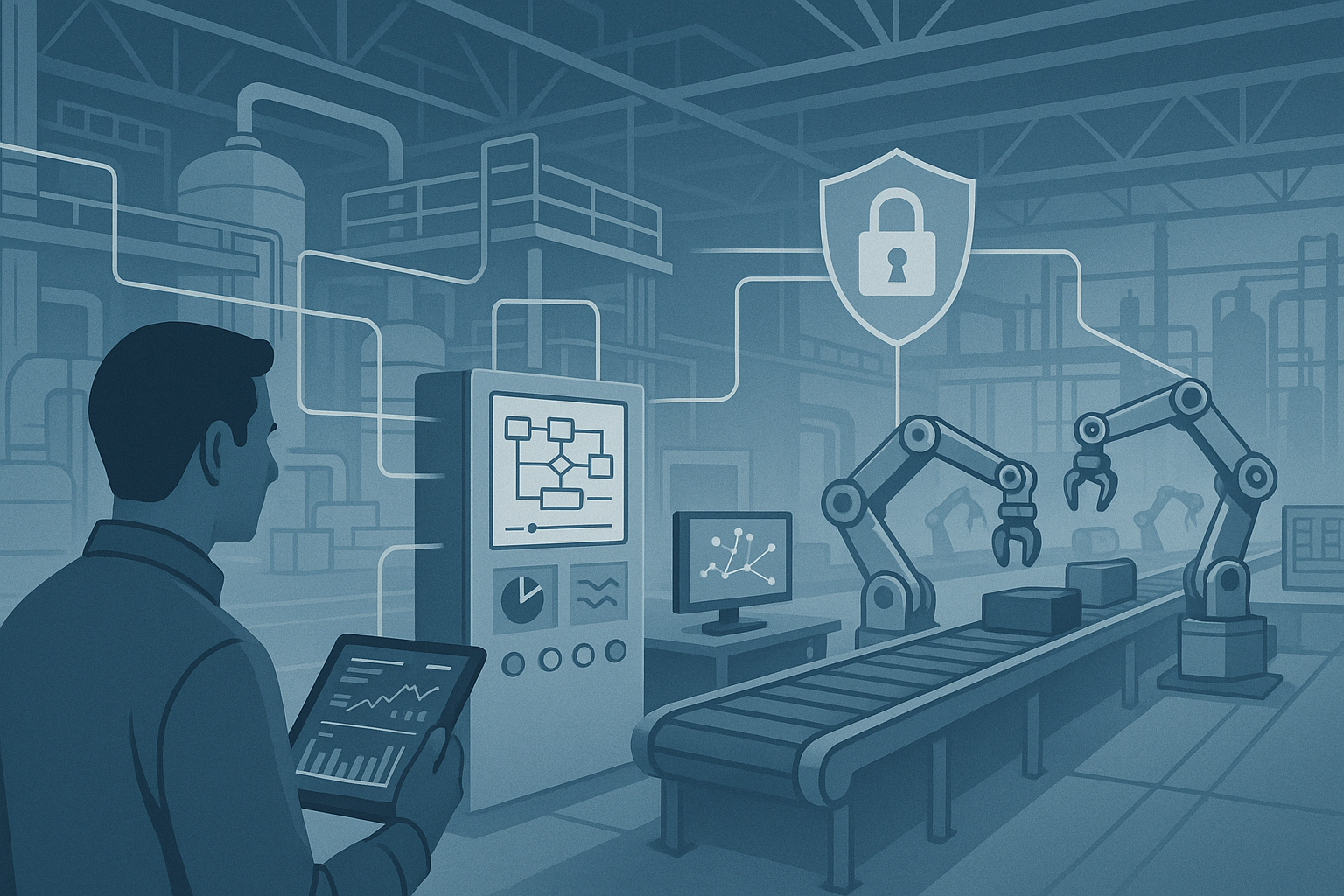
Industrial AI has moved into a more practical—and less forgiving—phase. A pilot can look strong on historical data long before a plant is ready to trust the same application on a running line, cell, or process unit. Recent coverage in Control Global, Automation.com, and Control Engineering points to the same conclusion: the constraint is shifting from AI curiosity to plant deployment discipline.
That support usually comes down to four gaps. Before AI can move reliably beyond pilot status, a plant needs usable OT data context, a clear path from insight to action, cyber and governance boundaries, and a defined owner for the workflow. The readiness burden is not identical for every use case. A maintenance decision-support tool has a lighter requirement than a system that can change a setpoint, alter a recipe, or influence a robot sequence. But the same four gaps still determine how far an AI project can safely go.
Gap 1: Data Context — Can the System Understand Operating State?
When engineers say “contextualized OT data,” the plain-English version is simple: not just what the tag did, but what the asset was doing when the tag changed. Control Engineering’s 2026 coverage on better OT data and data preparation for industrial AI makes that dependency explicit. AI, analytics, simulation, and advanced control all perform better when machine and process data are structured around operating state, not just collected in bulk.
In a process plant, that usually means connecting historian values to equipment state, operating mode, recipe or batch context, alarms, lab results, and maintenance history. In a discrete plant, it means linking PLC, robot, and vision data to work orders, machine states, cycle times, quality events, and downtime codes. Without that layer, an AI application may detect a change but still miss why it happened.
This is often where promising pilots lose momentum when they leave a cleaned-up project dataset and meet real plant behavior. Tag naming varies. Startup and changeover conditions look abnormal unless the system understands mode. Manual interventions appear in ways the model never saw during development. Before expanding a use case, it is worth asking a blunt question: can a new engineer understand operating state from the data alone? If not, the model probably cannot either.
Start here: standardize naming for the target asset or line, map operating states, and add the production context—product, batch, work order, recipe, or changeover status—that gives raw signals meaning.
Gap 2: Architecture — Can the Insight Reach the Point of Action?
Manufacturers do not need a full control-system overhaul before every AI use case can move forward. What they do need is a clear answer to a narrower question: where should this result appear, and who—or what—is supposed to act on it? Smart Industry’s 2026 article on process control for an AI-driven future and IndustryWeek’s 2026 piece on autonomous manufacturing fundamentals both connect AI progress to the control and application architecture underneath it.
That distinction matters. Some advisory applications can run beside existing systems with limited disruption. A quality-drift model might post ranked causes into HMI, SCADA, or MES workflows. A maintenance model may belong next to the historian and the computerized maintenance management system, or CMMS. A soft-sensor support application may fit inside an advanced process control or engineering workflow. The integration burden rises sharply only when the use case moves closer to closed-loop or semi-automated action.
Automation World’s 2026 coverage of strategic advanced process control in food production is a useful reminder here. Better results come from disciplined integration of analytics, process knowledge, and control strategy—not from laying a new algorithm on top of an unstable process. The same principle holds in discrete manufacturing. A recommendation on a bottleneck line is only useful if it reaches the line leader, maintenance technician, or cell controller in time to change the outcome.
Some plants will address this with modest changes to SCADA, historian, or application workflows. Others will need more deliberate modernization. The point is not modernization for its own sake. It is avoiding one more disconnected AI island.
Next: classify the use case as observe, advise, or act. Then decide where it should live—edge, SCADA/HMI, historian analytics, MES, CMMS, or a higher enterprise layer—based on who must respond and how quickly.
Gap 3: Cybersecurity and Governance — What Is the AI Allowed to Observe, Advise, or Act On?
As AI tools get closer to physical operations, governance stops being a software afterthought. Industrial Cyber’s 2026 coverage of Darktrace findings described growing concern about cyber exposure in AI-driven manufacturing environments. In a separate 2026 report, Industrial Cyber’s coverage of new CISA OT guidance pointed back to familiar OT basics—segmentation, secure remote access, visibility, and change management—as practical controls that reduce risk before more connected applications are introduced.
Automation World’s 2026 article on user-selected software agents in industrial automation adds another layer to the issue. Once AI tools can query plant systems directly or assemble operating context across multiple sources, manufacturers need explicit rules for what those tools can access, what they can recommend, and who can approve the next step.
A useful operating model is to separate permissions into three levels: observe, advise, and act. Observe means the system can see data and summarize or classify it. Advise means it can recommend a likely cause, maintenance action, or operating change. Act means it can trigger a command, suppress a step, or alter a sequence within defined limits. Those are not small differences. For most plants, the lower-risk place to start is observe or advise. The threshold is much higher once the application can influence machine or process behavior.
Before expanding: define access boundaries, log what the application queries and recommends, require human approval for any output with process or machine consequences, and manage higher-risk AI changes with the same seriousness applied to control logic changes.
Gap 4: Workflow Ownership — Who Responds, and How?
Technology does not close the loop on its own. Someone must decide what happens after the alert, recommendation, or forecast appears. Automation.com’s 2026 coverage of industrial AI readiness gaps and IndustryWeek’s 2026 autonomy article both reinforce the same point from different angles: scale depends on operational discipline as much as technical capability.
That is why workflow design matters as much as model accuracy. Operators need guidance that fits shift routines and alarm response. Maintenance teams need predictions tied to failure modes, spare parts, and planned downtime windows. Process and controls engineers need enough transparency to judge whether a recommendation is credible before it affects throughput, quality, or energy performance. If the output arrives outside those routines, adoption will be weak even when the model itself is technically sound.
A practical starting point is a bounded, clearly owned use case. Examples include quality-drift detection on a constraint line, advisory support for a soft sensor on a batch unit, maintenance decision support for a costly asset class, or energy optimization on a unit with a defined operating envelope. The common feature is not how advanced the model looks. It is that one team owns the KPI, the response, and the override.
To make it stick: give each use case a named plant owner, one primary KPI, a defined response step, and a review loop that checks whether the output was used and whether it improved the result.
A Practical Four-Step Sequence
If a manufacturer wants to move one AI use case beyond pilot status, the most practical sequence is straightforward:
1. Build context around one line, cell, or unit. Clean up names, states, and production context before expanding the dataset.
2. Decide where the output belongs. Put the recommendation in the workflow that already supports the decision—HMI, SCADA, MES, historian, CMMS, or engineering application.
3. Set the governance boundary. Be explicit about whether the system can only observe, can advise, or can act under defined approval rules.
4. Assign ownership before launch. Name the team, KPI, response procedure, and review cadence up front.
This is not a call for plantwide reinvention before any AI work can begin. Many advisory applications can start with a relatively modest footprint. But once a manufacturer wants repeatable, plant-scale results, the same four gates keep returning. Can the system understand operating context? Can the insight reach the right point of action? Are the cyber and governance boundaries clear? And does someone in the plant own the outcome?
If a use case cannot clear those four gates, it is probably still in pilot territory. That is the practical dividing line in industrial AI right now: not who can test a model, but who can place it inside a reliable plant workflow.
Sources consulted
- Control Global, "AI pilot era crosses a threshold" (2026) - https://www.controlglobal.com/control/ai-ml/article/55378160/ai-pilot-era-separates-those-can-and-cant-execute-artificial-intelligence
- Automation.com, "Report: Industrial AI Moves Into Physical Operations, Readiness Gaps Determine Scale" (2026) - https://www.automation.com/article/industrial-ai-moves-physical-operations-readiness-gaps-determine-scale
- Control Engineering, "Industrial AI performance optimization: better OT data needed" (2026) - https://www.controleng.com/industrial-ai-performance-optimization-better-ot-data-needed/
- Control Engineering, "How to optimize data for industrial AI, simulation, analytics, control" (2026) - https://www.controleng.com/how-to-optimize-data-for-industrial-ai-simulation-analytics-control/
- Smart Industry, "Reinventing process control for an AI-driven future" (2026) - https://www.smartindustry.com/benefits-of-transformation/advanced-control/article/55358903/reinventing-process-control-for-an-ai-driven-future
- IndustryWeek, "4 Fundamentals on the Path to Autonomous Manufacturing" (2026) - https://www.industryweek.com/technology-and-iiot/automation/article/55366866/4-fundamentals-on-the-path-to-autonomous-manufacturing
- Automation World, "Control System Integrators Association (CSIA): Strategic implementation of advanced process control in food production" (2026) - https://www.automationworld.com/control/article/55374254/control-system-integrators-association-csia-strategic-implementation-of-advanced-process-control-in-food-production
- Automation World, "Why bring your own agent changes industrial automation" (2026) - https://www.automationworld.com/factory/digital-transformation/article/55352483/why-bring-your-own-agent-changes-industrial-automation
- Industrial Cyber, "Darktrace identifies rising cyber exposure tied to AI-driven manufacturing operations" (2026) - https://industrialcyber.co/threats-attacks/darktrace-identifies-rising-cyber-exposure-tied-to-ai-driven-manufacturing-operations/
- Industrial Cyber, "CISA issues new OT security guidance to overcome cost and complexity barriers in critical infrastructure" (2026) - https://industrialcyber.co/industrial-cyber-attacks/cisa-issues-new-ot-security-guidance-to-overcome-cost-and-complexity-barriers-in-critical-infrastructure/