

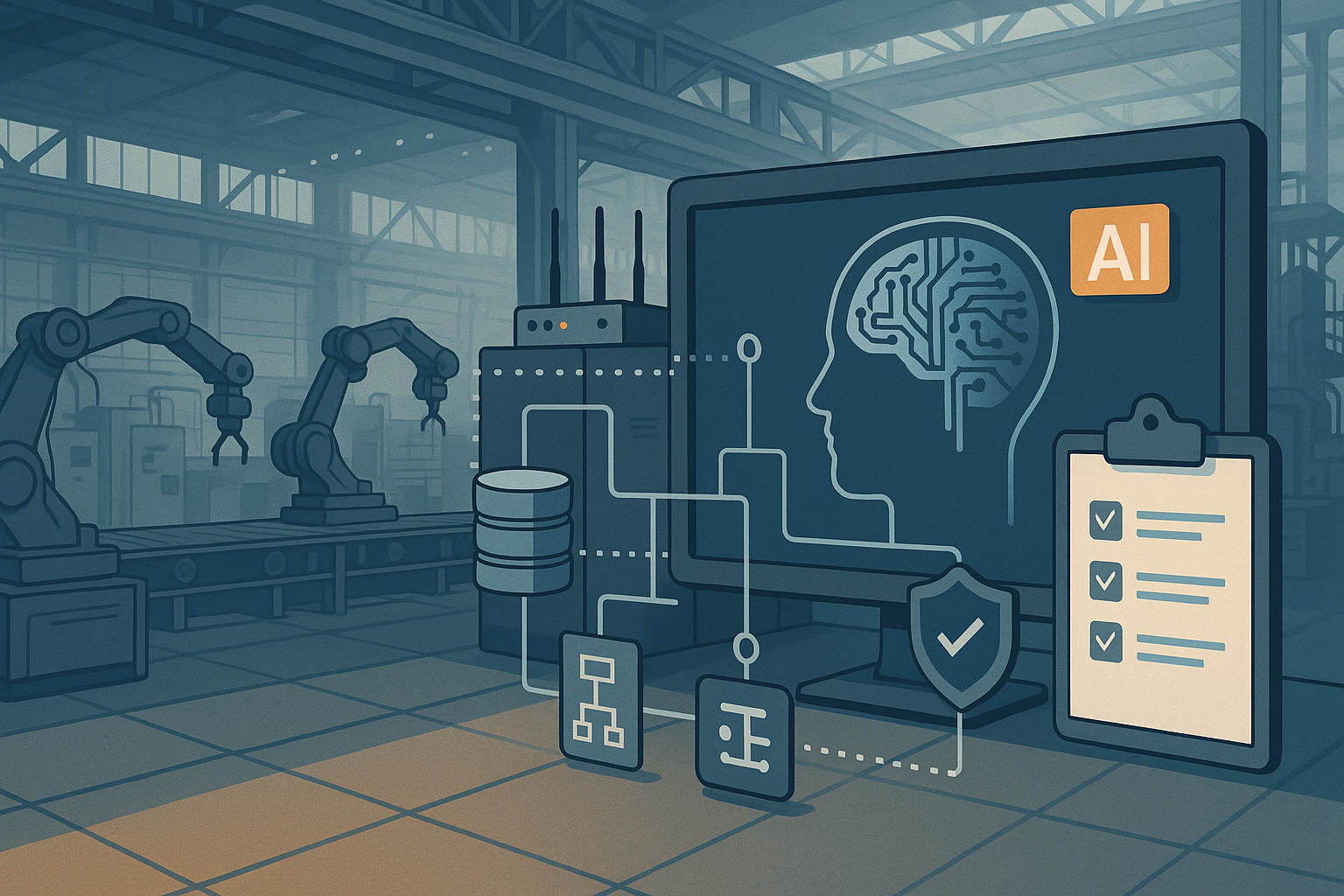
Industrial AI has moved past the experimentation phase. Manufacturers are already applying large language models, copilots, and early agents to maintenance troubleshooting, engineering support, document search, and other production-facing tasks. The main constraint is no longer interest. It is readiness. Before scaling industrial AI, most plants need to fix three basics: contextualize plant data, modernize the interfaces that expose that data, and define OT governance for how AI is allowed to read, recommend, and act (Automation World, Feb. 18, 2026; Automation.com, Apr. 7, 2026; Control Engineering, Feb. 19, 2026).
Model selection still matters, but it is usually not the first barrier. A pilot will struggle to survive first contact with real operations if the source data is inconsistent, every connection is custom, or no one has defined approval rules. That is true whether the use case is a maintenance copilot, an engineering assistant, or an agent that reaches across historians, MES, CMMS, and document repositories. Here is what fixing those three issues actually looks like.
- Contextualize the data around the use case
A large language model can answer questions from text. An AI agent goes further by retrieving information or taking steps across connected software (Automation World, Jan. 29, 2026). Neither is dependable if the plant’s own information lacks context. AI needs more than raw tags. It needs consistent asset names, operating state, alarms, batch or order context, maintenance history, and source documents that line up with the equipment and process involved.
The practical fix is to start small and specific. Standardize the naming and asset hierarchy for the equipment involved in the first use case. Connect the records that explain why a signal changed, not just the signal itself. Require answers to link back to the source historian trend, procedure, maintenance record, or quality report. Control Global recently argued that LLM outputs become far more useful when users can trace them back to source data, while Control Engineering’s “lifecycle-ready AI” discussion emphasized the value of AI that works across engineering, operations, and maintenance context rather than isolated snapshots (Control Global, Apr. 16, 2026; Control Engineering, Feb. 19, 2026).
The difference is easy to see on the plant floor. In a process facility, a vibration alert means little unless it is tied to equipment state, recent work orders, throughput, and alarm history. In discrete manufacturing, a cycle-time shift is much more useful when it is connected to part mix, changeovers, vision results, and robot cell status. If those relationships are missing, the AI may still produce fluent answers, but not reliable ones.
That is why the first data project for industrial AI should not be “collect more data.” It should be “clean and connect the context around one operational problem.” The best early candidates are issues that already matter every day: alarm triage, maintenance planning, engineering document search, root-cause analysis, and quality troubleshooting. Those use cases force the team to define which records, documents, and event histories actually need to be trustworthy.
- Replace one-off integrations with a repeatable interface layer
Many plants have enough data for AI on paper, but not enough structure for repeated deployment. The first pilot works because a team builds a special connection between a historian, an MES database, a CMMS table, and a document store. The second or third pilot becomes expensive because the same integration work has to be repeated. In brownfield environments, AI often exposes this problem quickly because every new use case touches more systems.
This is where architecture matters. A unified namespace, or UNS, is an information architecture pattern that gives applications a common, structured view of plant information. OPC UA is a standards-based way to exchange structured industrial data between systems. Software-defined control is different again; it is a control-platform approach that shifts more automation functionality into software and can simplify updates and lifecycle changes. These are complementary, not synonymous, and no plant needs to implement all of them at once. Their shared value is that they reduce dependence on brittle point-to-point integrations and create a cleaner path for new applications (Machine Design, Mar. 2, 2026; Automation.com, Apr. 22, 2026; Control Engineering, Jan. 30, 2026).
For most manufacturers, fixing the architecture does not mean a wholesale controls replacement. It means deciding where a common data model or interface layer should sit, exposing governed read access first, and making the next use case easier than the last. In a process site, that may involve aligning DCS, historian, lab, and maintenance data around equipment and batch context. In a discrete plant, it may mean connecting PLC, MES, quality, vision, and robot cell data so the AI sees the line as a process rather than a set of isolated machines.
Supplier roadmaps are moving in the same direction. Recent software-defined DCS and software-defined control launches have been positioned around lifecycle agility and faster system change, not only around controller hardware. That matters because industrial AI does not just need access to data; it needs an environment where new software can be added and maintained without turning every project into custom plumbing (Automation World, Feb. 24, 2026; Control Engineering, Jan. 30, 2026).
- Set OT governance before AI can cross system boundaries
Once AI can move across systems, governance becomes operational. It answers basic plant questions: What may the tool read? May it write back anywhere? When is human approval mandatory? How are prompts, recommendations, and actions logged? Who owns third-party access, identity management, and segmentation? ISA’s position paper on industrial AI and Industrial Cyber’s call for integrated cybersecurity strategies point to the same reality: AI changes automation practice, so cyber and operating controls need to be designed in from the start (ISA, Nov. 6, 2025; Industrial Cyber, Dec. 14, 2025).
That becomes more important as suppliers introduce copilots and agent-based tools that can work across multiple repositories and applications. Automation World’s reporting on bring-your-own-agent models suggests that plants may soon be managing several AI assistants at once, not a single isolated tool (Automation World, Jan. 29, 2026). The safest starting point is usually advisory work: troubleshooting support, document retrieval, maintenance planning, engineering search, and root-cause analysis. Broader autonomy should wait until decision rights, logging, third-party connectivity, and override procedures are documented.
Workflow belongs in the same discussion. An AI recommendation has little plant value unless it fits the way operators, technicians, engineers, and planners already make decisions. IndustryWeek argued that AI only pays off when work processes change with it, not when software is layered on top of unchanged routines (IndustryWeek, Jan. 15, 2026). In practice, that means tying every use case to an existing metric and approval path: alarm response, downtime, scrap, changeover time, maintenance backlog, or engineering cycle time.
A practical readiness check
Before approving the next pilot, run it through the same three filters that determine whether AI can survive outside the demo environment (Automation World, Feb. 18, 2026; Automation.com, Apr. 7, 2026; IndustryWeek, Jan. 15, 2026).
- Data: Are the required signals, events, documents, and records mapped to asset, batch, order, or machine context?
- Data: Can users trace the answer back to the source system or document?
- Architecture: Is there a stable interface layer, such as a governed API, UNS, or OPC UA model, instead of another one-off connection?
- Architecture: Can the current controls, SCADA, historian, MES, and maintenance stack support the use case incrementally?
- Governance: Are read/write permissions, human approval points, logging, and vendor access rules defined before rollout?
- Governance and workflow: Does the application improve a metric that operations, maintenance, engineering, or quality already owns?
Plants do not need perfect data or a finished modernization program before they start. They do need enough context, enough interface discipline, and enough governance to keep a promising pilot from stalling when it meets everyday operations. Fix those three areas first, and industrial AI has a much better chance of becoming a durable tool for production, maintenance, and engineering.
Sources consulted
- Automation World. “Will 2026 Be the Year AI Moves from Possibility to Production in Manufacturing?” Feb. 18, 2026. https://www.automationworld.com/analytics/article/55356840/deloitte-will-2026-be-the-year-ai-moves-from-possibility-to-production-in-manufacturing
- Automation World. “Schneider Electric Launches Software-Defined DCS.” Feb. 24, 2026. https://www.automationworld.com/control/news/55358237/schneider-electric-launches-software-defined-dcs
- Automation World. “Why Bring-Your-Own-Agent Changes Industrial Automation.” Jan. 29, 2026. https://www.automationworld.com/factory/digital-transformation/article/55352483/why-bring-your-own-agent-changes-industrial-automation
- Automation.com. “Report: Industrial AI Moves Into Physical Operations, Readiness Gaps Determine Scale.” Apr. 7, 2026. https://www.automation.com/article/industrial-ai-moves-physical-operations-readiness-gaps-determine-scale
- Automation.com. “OPC Foundation Advances OPC UA for the AI Era with Companion Specifications Optimized for Agentic AI.” Apr. 22, 2026. https://www.automation.com/article/opc-foundation-advances-opc-ua-ai-era-companion-specifications-optimized-agentic-ai
- Control Engineering. “Lifecycle-ready AI: unlocking value at every stage of process manufacturing.” Feb. 19, 2026. https://www.controleng.com/lifecycle-ready-ai-unlocking-value-at-every-stage-of-process-manufacturing/
- Control Engineering. “Use software-defined control to get smarter, faster, more agile manufacturing.” Jan. 30, 2026. https://www.controleng.com/use-software-defined-control-to-get-smarter-faster-more-agile-manufacturing/
- Smart Industry. “Crystal Ball 2026: The year AI moves from promise to production.” Dec. 26, 2025. https://www.smartindustry.com/special-reports/article/55337079/crystal-ball-2026-the-year-ai-moves-from-promise-to-production
- ISA. “ISA Explores Industrial AI’s Impact on Automation in a New Position Paper.” Nov. 6, 2025. https://www.isa.org/news-press-releases/2025/november/isa-explores-industrial-ai-s-impact-on-automation
- IndustryWeek. “What Must Change for AI to Pay Off?” Jan. 15, 2026. https://www.industryweek.com/technology-and-iiot/emerging-technologies/article/55343848/what-must-change-for-ai-to-pay-off
- Machine Design. “The Future of Smart Manufacturing Relies on a UNS.” Mar. 2, 2026. https://www.machinedesign.com/automation-iiot/article/55361007/highbyte-the-future-of-smart-manufacturing-relies-on-a-uns
- Control Global. “Data-source links let LLMs understand and deliver.” Apr. 16, 2026. https://www.controlglobal.com/control/ai-ml/article/55371448/data-source-links-let-large-language-models-understand-and-deliver
- Industrial Cyber. “2026 and beyond: Urgent need for integrated cybersecurity strategies in evolving industrial landscape.” Dec. 14, 2025. https://industrialcyber.co/features/2026-and-beyond-urgent-need-for-integrated-cybersecurity-strategies-in-evolving-industrial-landscape/