

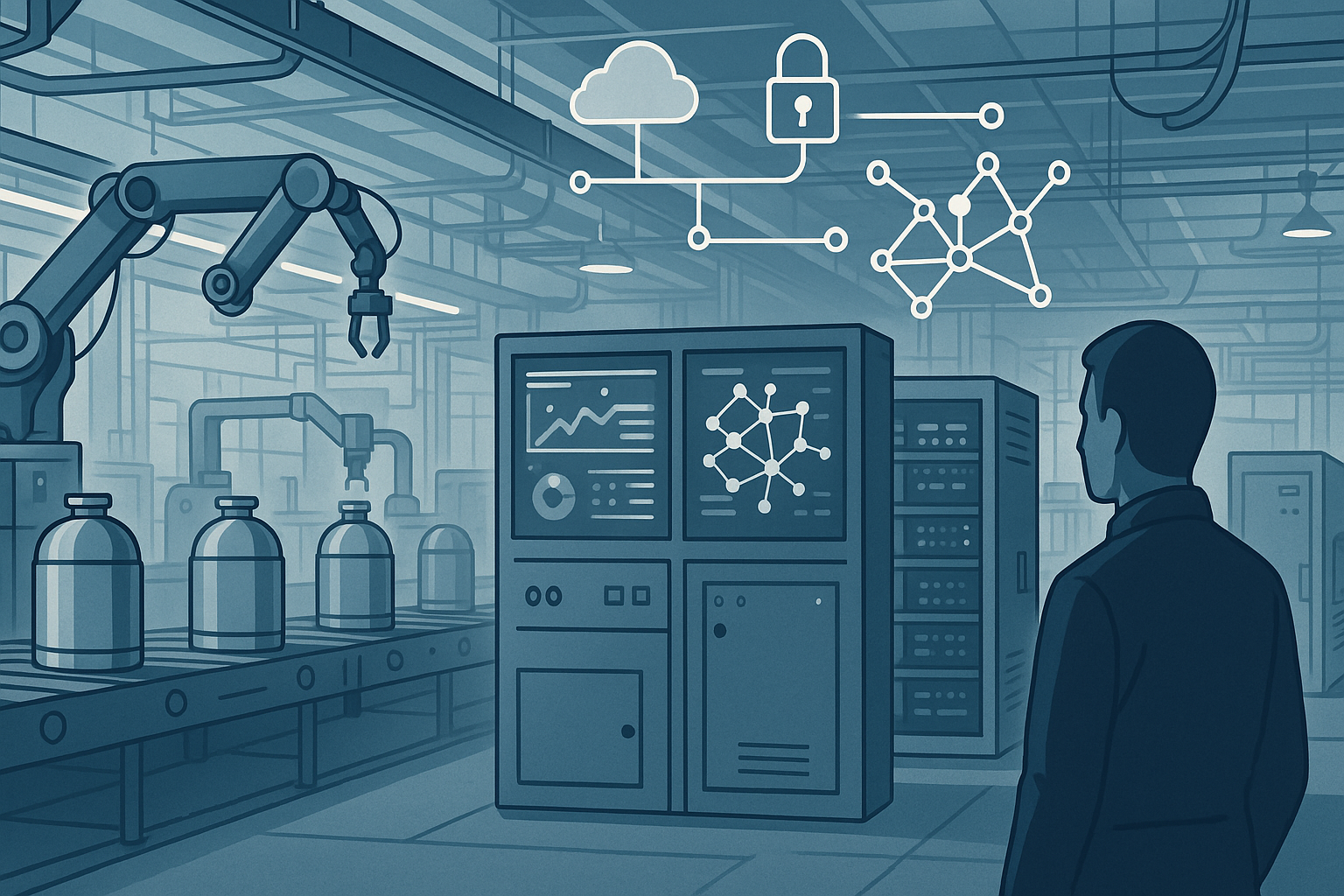
Industrial AI pilots rarely stall because the model cannot produce an answer. They stall because the data was hand-prepared, the integration only worked on one line, the cybersecurity review arrived late, or the output still depended on one expert to interpret it. That is why the main constraint in manufacturing is no longer access to AI tools; it is readiness at the plant and workflow level (Smart Industry, "Crystal Ball 2026"; IndustryWeek, "Turning Awareness Into Action"; Machine Design, "Avoiding Last-Mile Failures").
In this article, the term "AI agents" refers to the agentic systems now entering industrial discussions: software that can pull context from several sources, work through a sequence of tasks, and return a recommendation or a narrowly defined action. On the plant floor, value from that kind of system is concrete. It shows up as faster troubleshooting, less manual engineering, quicker quality response, or fewer minutes of downtime on a bottleneck asset. If it does not shorten a recurring plant decision, it has not created plant-floor value yet.
Not every use case needs the same depth of preparation. A read-only maintenance assistant carries far less risk than an agent allowed to open a work order, change a schedule, or influence a process decision. Consider a troubleshooting agent for a high-speed packaging line: it pulls PLC alarms, vision rejects, robot cycle times, historian trends, recent maintenance activity, and operating procedures, then tells the team what likely caused a slowdown and what to check first. Once a pilot like that moves toward production use across shifts, lines, or sites, five readiness layers usually decide whether it remains a promising proof of concept or becomes a supportable operating tool: usable context, shared meaning across systems, fit-for-purpose deployment, OT access governance, and a clear human handoff (Automation World, "Cloud, Edge and Field Environments"; Automation.com, "Eight AI Trends"; Control Global, "Automation to Reasoning").
Layer 1: Give the agent usable context
Most plants do not lack data. They lack data that an agent can interpret correctly without a human translator. A pilot can survive with manually mapped tags and a subject-matter expert nearby. Production use cannot. If the packaging-line agent cannot tell whether a fault happened before or after a changeover, whether the line was in production or maintenance mode, or whether a robot stop coincided with a rise in vision rejects, its advice will be shallow or misleading.
That is the practical warning behind recent historian coverage: when collection outruns structure, historians can become "digital landfills" rather than decision tools. For an AI agent, context should include asset hierarchy, operating mode, recipe or SKU, recent work orders, alarm history, and operator notes, not just time-stamped values. This is also where pilot-to-production efforts often break first: an engineer can explain missing metadata during a proof of concept, but the live system has to survive shift turnover and equipment swaps without that interpreter. Done well, this layer turns raw signals into faster root-cause analysis and fewer false leads (Automation.com, "Data Historians"; Machine Design, "Avoiding Last-Mile Failures").
Layer 2: Make systems speak a shared language
A connected facility is not necessarily an understandable one. For AI agents, interoperability means more than moving data between systems. It means the software can tell what an asset, alarm, job, or event actually is. If the same filler appears as FLLR-03 in the PLC, Line3/Filler in the historian, and Asset 4421 in the CMMS, every scale-up effort starts with translation.
This is why standardized semantics around OPC UA and the wider push toward letting different AI agents work across the same environment matter. In plain English, the systems need a shared structure that lets software recognize whether a point is a motor current, a quality alarm, a machine state, or a batch event. The same issue applies to documents and workflow states: a line clearance, quality hold, or maintenance completion step needs a consistent meaning if an agent is going to reuse it across lines or sites. A common structure allows the packaging-line agent to link a motor load spike, a robot fault, and a reject trend into one event chain instead of treating them as unrelated signals. It also cuts the custom integration work needed to expand from one pilot cell to the next (Automation World, "Bring-Your-Own-Agent"; Automation.com, "OPC UA for the AI Era").
Layer 3: Put each agent where the decision lives
Many AI projects are still framed as a cloud question. On a production site, the better question is where the decision needs to happen. A cloud service may be ideal for cross-site document search, engineering knowledge capture, or benchmarking. An edge deployment may be better for line-side vision, local troubleshooting, or any use case that needs low latency and has to keep working through a network interruption. Functions that sit close to controls or process response demand even tighter placement and clearer boundaries.
For the packaging-line example, the agent might search manuals and past reports in the cloud, but evaluate machine-state patterns locally at the edge so response time and resilience do not depend on a wide-area connection. The same principle holds in process operations: advisory tools tied to advanced process control or control-room response typically belong much closer to the process than enterprise reporting tools do. Placement also affects supportability. If the people responsible for the line cannot tell what happens when connectivity drops, the architecture is not ready. Choosing the runtime correctly reduces delays, support issues, and the temptation to force every use case into one architecture (Automation World, "Cloud, Edge and Field Environments"; Control Global, "AI Reduces Time to Value in Advanced Process Control").
Layer 4: Govern access before you govern intelligence
For many plants, the hardest question is not how smart the agent is. It is what the agent can touch. A troubleshooting agent that reads PLC alarms, robot controller logs, historian data, quality records, and CMMS tickets is already reaching into several systems with different permissions. If it can open a ticket, request a parameter check, or trigger a downstream workflow, the governance requirements rise again.
This is where ISA/IEC 62443-style thinking becomes useful. Before rollout, the team should define network zones, permitted connections, service accounts and credentials, approval rules, logging, and what actions remain human-confirmed. The governance plan should cover internal users, outside integrators, OEM support, and any cloud services that participate in the workflow. The risk profile changes materially as an agent moves from read-only advice to a limited, preapproved action inside an operational workflow, which is why access design has to be settled before the project touches production systems. Plants that do this work early are less likely to discover, late in the project, that the useful workflow is the one security or operations cannot support (Automation.com, "ISA/IEC 62443 Perspective"; Automation World, "Bring-Your-Own-Agent").
Layer 5: Design the human handoff
Even a well-integrated, well-governed agent will fail if its role in the workflow is vague. Operators and technicians need to know what the system is allowed to do, what evidence it used, how to accept or reject the recommendation, and who owns the next step when the answer is wrong or incomplete. A pilot can hide that ambiguity because the project team is standing nearby; production use cannot.
On the packaging line, the first production-ready version may simply rank likely causes of a slowdown, cite the alarms and work-order history behind its reasoning, and draft the next maintenance step for approval. A later version might open the work order automatically or queue an inspection, but only after the site is comfortable with the exception handling and audit trail. Sites also need a named owner for the agent's instructions, workflow logic, exception rules, and update cycle; otherwise the system becomes nobody's responsibility after go-live. That progression from adviser to limited-action tool is where many projects either gain trust or lose it (IndustryWeek, "Turning Awareness Into Action"; Machine Design, "Avoiding Last-Mile Failures"; Control Global, "Automation to Reasoning").
What changes from pilot to production
A pilot proves that the idea can work. Production scale proves that it can keep working. The model itself may not change much. What changes is everything around it: naming standards, support ownership, cybersecurity review, version control, shift training, behavior during an outage, and the ability to extend the design to the second and third line without rebuilding the integration by hand. That is why some successful-looking pilots stall at rollout while more modest ones spread quickly across an operation (Machine Design, "Avoiding Last-Mile Failures"; Smart Industry, "Crystal Ball 2026").
The simplest test is whether the agent can survive ordinary plant variability. Can it handle a controller replacement, a renamed tag, a new recipe, a different shift crew, or a temporary loss of connectivity? If not, the project may still be worth continuing, but it is not ready to scale. A sensible first target is a recurring decision on a bottleneck asset: why the line slows after changeover, why a quality drift returns, or why the same machine trips during the same operating window.
A five-question scale-up check
Before approving the next AI-agent rollout, ask:
- What operational decision will the agent improve, and how will value be measured?
- What context must it see to answer correctly?
- Do the source systems describe assets and events consistently enough to reuse the design elsewhere?
- Should this function run in the cloud, at the edge, or close to the process?
- What can it read, what can it trigger, and who owns the final decision when the recommendation is wrong?
If those questions are hard to answer, the project is still in pilot mode. That is not a setback; it is a clear next-step plan. In most factories, the first scalable AI agent will not be the most autonomous one. It will be the one that fits the site's data, architecture, cybersecurity rules, and daily work well enough to keep delivering value after the launch team steps away. That is how plant-floor value is created: not by adding another model, but by building an environment an AI agent can understand and operate within safely.
Sources consulted
- Smart Industry — "Crystal Ball 2026: The year AI moves from promise to production" — https://www.smartindustry.com/special-reports/article/55337079/crystal-ball-2026-the-year-ai-moves-from-promise-to-production
- IndustryWeek — "Turning Awareness Into Action With Agentic AI" — https://www.industryweek.com/technology-and-iiot/emerging-technologies/article/55384020/turning-awareness-into-action-with-agentic-ai
- Automation World — "Why Industrial AI Success Can Require Deployment Across Cloud, Edge and Field Environments" — https://www.automationworld.com/analytics/article/55343095/why-industrial-ai-success-can-require-deployment-across-cloud-edge-and-field-environments
- Automation World — "Why Bring-Your-Own-Agent Changes Industrial Automation" — https://www.automationworld.com/factory/digital-transformation/article/55352483/why-bring-your-own-agent-changes-industrial-automation
- Automation.com — "From the Editor: Eight AI Trends Reshaping Industrial Operations in 2026" — https://www.automation.com/article/eight-ai-trends-reshaping-industrial-operations-2026
- Automation.com — "OPC Foundation Advances OPC UA for the AI Era with Companion Specifications Optimized for Agentic AI" — https://www.automation.com/article/opc-foundation-advances-opc-ua-ai-era-companion-specifications-optimized-agentic-ai
- Automation.com — "Data Historians: Turning Digital Landfills Into Strategic Assets" — https://www.automation.com/article/data-historians-turning-digital-landfills-strategic-assets
- Automation.com — "Simplifying Likelihood in OT Risk Assessments: A Practical ISA/IEC 62443 Perspective" — https://www.automation.com/article/simplifying-likelihood-ot-risk-assessments-practical-isa/iec-62443-perspective
- Machine Design — "AI Adoption in Manufacturing: Future Tech’s Matt Scavetta on Avoiding Last-Mile Failures" — https://www.machinedesign.com/automation-iiot/article/55340740/ai-adoption-in-manufacturing-future-techs-matt-scavetta-on-avoiding-last-mile-failures
- Control Global — "Controls industries shift from automation to reasoning" — https://www.controlglobal.com/network/industrial-networks/article/55383796/controls-industries-shift-from-automation-to-reasoning
- Control Global — "AI reduces time to value in advanced process control" — https://www.controlglobal.com/show-coverage/honeywell-users-group/article/55383228/ai-reduces-time-to-value-in-advanced-process-control