

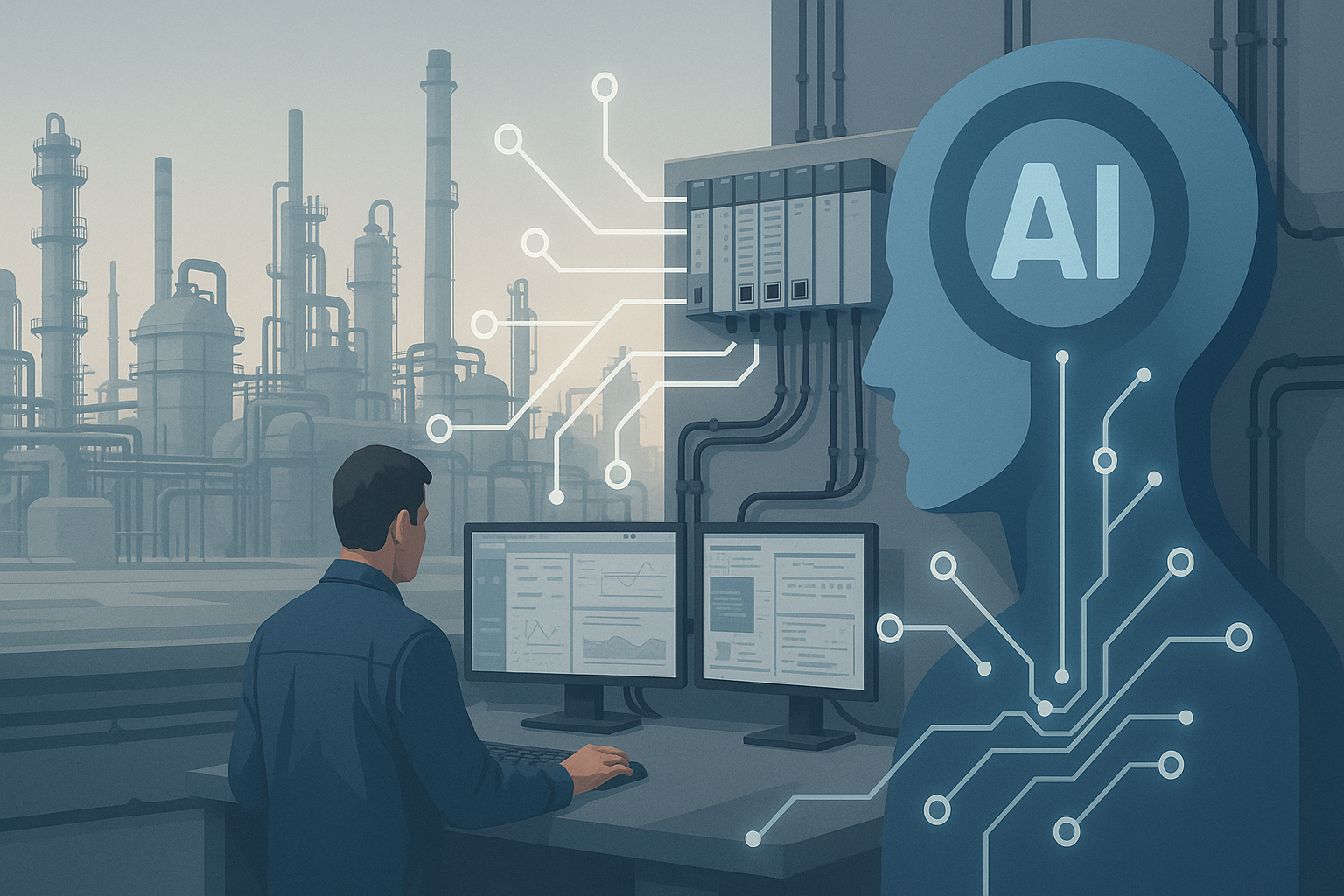
Most manufacturers do not need a new control architecture to start getting value from AI. They need to put AI in the layer above control: troubleshooting, document retrieval, shift handoff, maintenance triage, and engineering support around the systems already in place.
That boundary matters. PLCs, DCSs, and safety systems are there to run the process predictably. AI tools are better suited to advisory work that depends on search, context, pattern detection, and summarization. Automation World argued for that “augment, don’t replace” approach, and Control Engineering’s lifecycle-ready AI coverage pointed in the same direction: add intelligence around plant work before asking AI to influence plant control (Automation World; Control Engineering).
Start with the layer above control
In a typical plant, the AI discussion gets muddled because very different tools get lumped together. For a practical rollout, it helps to separate them.
- Analytics use historian, SCADA, MES, or condition data to detect anomalies, estimate loss, or rank likely causes of poor performance.
- Copilots assist a person. They retrieve documents, summarize alarms and notes, draft reports, or help someone work through a procedure.
- Reasoning agents go a step further. Smart Industry used the term for tools that can pull context from several approved systems and follow a defined workflow to return a recommendation, with the goal of expanding scarce expert decision capacity rather than replacing it (Smart Industry).
Those tools usually belong above the control layer. Below them sit controllers, drives, and safety logic. Around them sit HMI and SCADA. Above them sit the historian, MES, maintenance systems, document repositories, and edge or cloud data services. That is where AI usually makes sense first: reading from operational and support systems, then returning guidance to people.
The key is boundary setting. Early deployments should be read-only to production systems. A plant may allow an agent to draft a maintenance note, assemble a shift summary, or prepare a troubleshooting checklist. It should not let a black-box tool quietly alter setpoints, rewrite control logic, or bypass safety interlocks. In regulated processes and safety-instrumented environments, that line should be even firmer.
A practical brownfield scenario
Consider a packaging line that loses 20 to 30 minutes during some changeovers. The PLC captures the fault bits. The HMI shows alarm history. The historian records speed, motor load, and reject counts. The maintenance system contains three similar work orders from the previous quarter. The OEM manual sits in a shared drive. The information exists, but it is scattered.
This is where the tool categories separate:
- An analytics tool spots that the stops cluster around one SKU family and one specific sequence of setup changes.
- A copilot pulls the current setup standard, the OEM torque limit, the last three work orders, and the supervisor’s note from the last event.
- An agent assembles those inputs into a recommended check sequence for the technician and drafts the maintenance note for review.
The machine still runs on PLC logic. The technician and supervisor still make the call. AI simply shortens the time between fault and informed action. That is much closer to the engineering-support and maintenance-support use cases described by A3/Automate.org, Smart Industry, and Control Engineering than to any vision of autonomous plant control (A3/Automate.org; Smart Industry; Control Engineering).
Context before model selection
The hard part is usually not model selection. It is context.
An AI tool cannot help much if it cannot tell which asset a tag belongs to, which document revision is current, or whether a work order applies to the same machine family. Plants often discover that the needed information exists, but lives in separate systems with different naming, ownership, and approval rules.
For most sites, the minimum usable context set is not glamorous, but it is decisive:
- an authoritative asset hierarchy and naming standard;
- current procedures, manuals, and engineering documents;
- alarm and event history tied to operating state;
- maintenance history and failure codes;
- clear read permissions, retention rules, and audit logs.
IndustryWeek’s article on automation adoption made the human version of this point: technology does not rescue an operation if people cannot use it correctly inside real workflows. Control Engineering made the system version: value comes from tying AI to the right lifecycle information, not just adding a model on top of raw signals (IndustryWeek; Control Engineering).
This is also why many first projects should stay narrow. A plant does not need a grand “AI everywhere” architecture to prove value. It needs one workflow with trustworthy inputs. If the first use case is downtime diagnosis on one line, then build the data set for that line first. If the first use case is engineering document retrieval, then fix the document control and metadata for that scope first.
Where possible, test the workflow on historical data, in a sandbox, or in a digital twin before anyone depends on it during production. Automation.com and Control Global both highlighted digital twins as a practical way to validate logic and reduce modernization risk before touching a live process (Automation.com; Control Global).
Not every site needs a high-fidelity digital twin to do this well. In many plants, replaying historical events in a small validation environment is enough to show whether the tool is retrieving the right context and surfacing recommendations that operators and engineers will actually trust.
When AI is not the first fix
Augmentation is not always step one.
If the control platform is unsupported, the network map is incomplete, the asset hierarchy is missing, or critical data is trapped in isolated systems with no clean interface, the plant may need modernization work before it needs an AI pilot. The same is true when a facility has weak document control or no clear ownership of maintenance and alarm history.
Safety and regulatory requirements also change the answer. In a safety-instrumented or heavily validated environment, AI may still help with engineering review, training, deviation analysis, or document preparation. But direct control influence should stay off the table until governance, validation, and change-control expectations are clear. Control Global’s reporting on long-term DCS and SIS support and IndustryWeek’s article on the foundations of autonomous manufacturing underscore the same reality: stable platforms and trustworthy data are prerequisites, not side issues (Control Global; IndustryWeek).
Treat AI as another OT-connected system
If the AI tool touches plant data, do not wait until phase two to decide who can connect, what data can leave the site, or how supplier sessions are controlled. Security and governance are part of deployment, not cleanup.
Three controls matter early:
1. Least-privilege access Start with the smallest read-only data set that supports the first use case. Do not grant broad visibility just because it might be useful later.
2. Remote-access discipline Automation.com highlighted supplier access as an OT security risk, and ISA-linked material carried by Automation.com warned that some OT devices remain unintentionally visible from outside the plant. Industrial Cyber, citing Secomea’s vendor-backed 2026 remote-access report, described vendor sprawl and weak credentials as continuing concerns (Automation.com; Automation.com; Industrial Cyber).
3. Approved tools and audit trails If the plant does not define an approved AI stack, users will try public models or unapproved agents against plant information. Automation World’s article on “bring-your-own-agent” raised that governance problem directly (Automation World).
The audit point is easy to miss. Every recommendation that could affect production should preserve the source data, the output, and the human approval record. If a supervisor cannot answer what the tool saw, what it recommended, and why the team acted on it, the deployment is not ready to scale.
A rollout sequence that survives startup
A brownfield AI program does not need a transformation slogan. It needs order.
1. Choose one decision bottleneck and one KPI. Start with a problem the plant already feels: mean time to diagnose a trip, time to find the right procedure, changeover losses, or repetitive engineering lookups. One use case and one KPI make it much easier to judge whether the tool helped.
2. Keep the first application advisory. Let the tool summarize, retrieve, rank, and recommend. Keep control actions, setpoint changes, and safety functions in existing deterministic systems and under normal approval rules.
3. Build the minimum context set. Do not wait for a perfect enterprise data model. Build just enough structure around assets, documents, alarms, and maintenance history to support the first workflow.
4. Validate before live reliance. Run the workflow against historical events, a test environment, or a digital twin. The question is not just technical accuracy. It is operational usefulness: did the tool point the team to the right evidence quickly enough to matter?
5. Standardize governance before scaling. Once one line or area works, document the access model, approved data sources, human approval points, and audit requirements. Then repeat the pattern. Scaling a poorly governed pilot only spreads the weakness.
The practical takeaway
In an existing plant, AI usually earns its keep first as decision support around the control system, not as a substitute for it. Put it where it can shorten troubleshooting, surface plant knowledge, and standardize responses. If the data context, platform support, or access control are not ready, fix those first. That sequence may look less dramatic than a full-stack AI pitch, but it is the one most likely to survive startup, night shift, and audit day.
Sources consulted
- Automation World — “Augment, Don’t Replace: The New Playbook for AI in Industrial Automation” — https://www.automationworld.com/factory/digital-transformation/article/55372960/augment-dont-replace-the-new-playbook-for-ai-in-industrial-automation
- Automation World — “Why Bring-Your-Own-Agent Changes Industrial Automation” — https://www.automationworld.com/factory/digital-transformation/article/55352483/why-bring-your-own-agent-changes-industrial-automation
- Control Engineering — “Lifecycle-ready AI: unlocking value at every stage of process manufacturing” — https://www.controleng.com/lifecycle-ready-ai-unlocking-value-at-every-stage-of-process-manufacturing/
- Smart Industry — “Expanding expert decision capacity with AI reasoning agents” — https://www.smartindustry.com/artificial-intelligence/article/55375582/expanding-expert-decision-capacity-with-ai-reasoning-agents
- A3 / Automate.org — “AI Copilots Gaining Traction in Industrial Automation” — https://www.automate.org/ai/blogs/ai-copilots-for-industrial-automation
- IndustryWeek — “Automation Won’t Save You If Nobody Uses It Correctly” — https://www.industryweek.com/technology-and-iiot/automation/article/55375248/automation-wont-save-you-if-nobody-uses-it-correctly
- IndustryWeek — “4 Fundamentals on the Path to Autonomous Manufacturing” — https://www.industryweek.com/technology-and-iiot/automation/article/55366866/4-fundamentals-on-the-path-to-autonomous-manufacturing
- Automation.com — “When Supplier Access Becomes an OT Security Risk” — https://www.automation.com/article/supplier-access-becomes-ot-security-risk
- Automation.com — “Defining Digital Twin: History, Attributes and Examples” — https://www.automation.com/article/defining-digital-twin
- Automation.com — “The Unknown Risk: Are Your OT Devices Unintentionally Visible to Malicious People?” — https://www.automation.com/article/unknown-risk-ot-devices-unintentionally-visible-malicious-people
- Control Global — “Advances in digital twins are key to process control” — https://www.controlglobal.com/visualize/article/55362289/advances-in-digital-twins-are-key-to-process-control
- Control Global — “Long-term support for DCS and SIS enables software-defined automation” — https://www.controlglobal.com/control/distributed-control/product/55373778/emerson-automation-solutions-long-term-support-for-dcs-and-sis-enables-software-defined-automation
- Industrial Cyber — “Secomea’s State of Industrial Remote Access 2026 reveals vendor sprawl and weak credentials undermining OT security” — https://industrialcyber.co/reports/secomeas-state-of-industrial-remote-access-2026-reveals-vendor-sprawl-and-weak-credentials-undermining-ot-security/